
BYD DOLPHIN Towing System User Guide
The lightweight towing system of the BYD Dolphin is intended for light-duty hauling. Its modest towing capability and detachable tow hook make it appropriate for tiny trailers or bike racks, increasing the vehicle’s urban utility and adaptability.
2023 BYD HAN EV Review, Price, Features and Mileage (Brochure)
BYD If the Vehicle Needs Towing Guide
If the vehicle needs towing, it is recommended to contact a BYD authorized dealer or service provider, a professional towing service, or the organization you joined for roadside assistance.
WARNING
- The vehicle must not be towed by other vehicles using only ropes or chains.
Recommended towing method:
- Flatbed device
- If the vehicle fails and needs towing, a flatbed is recommended. When the vehicle is being towed, keep its four wheels off the ground. Towing the vehicle on front or rear wheels alone may damage high-voltage components.
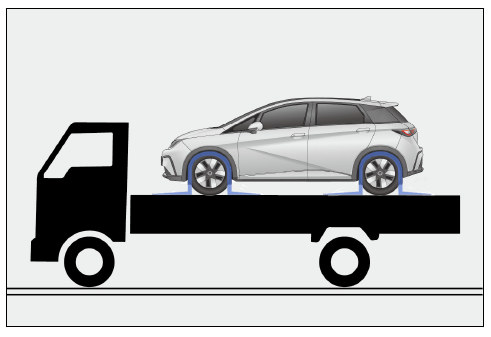
- If the vehicle fails and needs towing, a flatbed is recommended. When the vehicle is being towed, keep its four wheels off the ground. Towing the vehicle on front or rear wheels alone may damage high-voltage components.
CAUTION
- When using a flatbed device, make sure the vehicle is securely fastened to prevent it from sliding.
- It is recommended to use professional tie-down straps and tensioners, and employ the over-the-wheel method to secure the vehicle.
- When fixing the vehicle, do not pass the fixtures such as straps and ropes through the wheels or tie them on the chassis, suspension and other body parts to prevent damaging the vehicle.
- Ensure the vehicle’s wheels are immobilized during transport to prevent potential damage.
Tow Eye
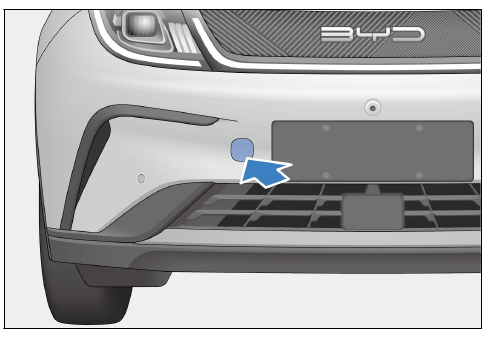
The tow eye cover is at the upper right corner of the front bumper, with the installation position shown in the diagram.
- Press to open the tow eye cover.
- Install the tow eye in the tow eye opening.
- If the vehicle needs rescue, it is recommended to call a professional rescue or the customer service number.
- In emergency rescue situations where the vehicle needs to be towed, observe the following to avoid vehicle damage or personal injuries:
- The towing vehicle must be in good conditions and the towed vehicle in Neutral; the tow speed must be no more than 5 km/h.
- Never use jerking actions to pull the vehicle.
- The towed vehicle must not carry any person except for the driver.
- Both towing and towed vehicles must have their hazard warning lights on.
- Only the in-vehicle tow eye can be used, to avoid damages to the vehicle.
- The distance between the towing and towed vehicles must be more than 4 meters but less than 10 meters.
- The width and weight of the towed vehicle must not be greater than those of the towing vehicle.
- When the vehicle is being towed, ensure its surroundings are unobstructed and have enough space and no person is close to the towing device.
- When freeing the vehicle, control to make it travel in the direction of tow force. Dragging the vehicle from the side or vertically is prohibited.
- The towed vehicle must be controlled by a driver inside the cabin, with the steering and braking systems in normal conditions.
WARNING
- Rescuing a stuck or high-centered vehicle by using the tow eye
is prohibited. Instead, calling a professional rescue or the customer service number is recommended. - If the steering or braking system of the towed vehicle fails, contact a professional rescue or the customer service number. Do not tow the vehicle in such cases.
If a Tire Goes Flat
- In case of a flat tire, slow down, keep straight, and drive off the busy road to a safe place.
- Park on solid, flat ground and avoid motorway forks.
- Engage the EPB and press the “P” button.
- Power off the vehicle and turn on the hazard warning light.

- Be sure to have all passengers get off the vehicle and ask them to go to a safe place away from crowded traffic.
- To prevent slipping, secure the vehicle by wedging the tire diagonally against the flat tire.
CAUTION
- Do not continue driving with a flat tire. Driving even a short distance can cause too severe damage for the tire to be repaired.
In-Vehicle Tools*
These include: warning triangle, reflective vest, lug nut cap removal clamp, tire repair kit, and tow eye. The reflective vest is in passenger’s glove box, and other tools are stored in the tool box under the trunk cover flap.
- Warning triangle
- Lug nut cover removal clamp
- Tire repair kit
- Tow eye
- Reflective vest

Placing the warning triangle
REMINDER
- When parking for repair, remember to place the red triangle side facing oncoming vehicles, 100-200 meters away from the vehicle. After the repair, recover the warning triangle for future use.
The warning triangle is used to warn vehicles coming from behind and to avoid collisions due to high speed or late braking.
How to use the warning triangle:
- Take the warning triangle out of its box.
- Attach the ends to form a triangle.
- Mount the supports as shown.

Using Tire Repair Kit
- The tire repair kit is used to seal small cuts, especially cuts in tread pattern. It is just an emergency solution for you to drive to the nearest service center, and only for short emergency stretches, even if the tire is not deflated.
WARNING
- At most, the tire repair kit can repair holes that are on the tire tread and are within 6 mm in diameter. Do not use the kit on holes with larger diameters or in other tire positions, but call for roadside assistance instead.
- Tire sealant is highly flammable and harmful to health. Take necessary precautions to prevent fire and avoid contact with skin, eyes, and clothing; keep away from children; and do not inhale its vapor.
In case of contact with tire sealant:
- If tire sealant comes into contact with the skin or gets into
the eyes, thoroughly flush the affected body part immediately with plenty of clean water. - Change contaminated clothing immediately.
- In case of an allergic reaction, seek medical attention immediately.
- If tire sealant is ingested by accident, rinse mouth thoroughly and drink plenty of water immediately. Do not induce vomiting, but seek medical attention immediately.
Using the Tire Repair Kit
- Refer to the labels on the inflator and tire sealant for usage of the kit.
- If the inflator needs to be connected to a power source, plug the inflator into the vehicle’s 12V socket, start the vehicle, and turn on the inflator. The tire sealant is then filled through the inflator hose into the tire along with air.
REMINDER- Make sure the inflator switch is off when you plugging the power supply into the 12V socket in the vehicle.
- The inflator can only be turned on for up to 10 minutes.
- Observe the tire pressure reading on the inflator.
- If the tire pressure does not reach 180 kPa (1.8bar) within 10 minutes (red area shown in the figure), turn off the inflator. You are recommended to contact a BYD authorized dealer or service provider.

- If the tire pressure reaches between 180 and 320 kPa (1.8-3.2bar) (green and yellow areas shown in the illustration), remove the kit as soon as possible and drive at a speed below 80 km/h within one minute, with the furthest driving distance not exceeding 10 km, so that the tire sealant is evenly distributed within the tire.

- If the tire pressure does not reach 180 kPa (1.8bar) within 10 minutes (red area shown in the figure), turn off the inflator. You are recommended to contact a BYD authorized dealer or service provider.
- Stop to check the repaired tire and the tire pressure reading on the inflator.
- If the tire pressure is greater than 220 kPa (2.2 bar), drive to the nearest service center at a speed below 80 km/h.
- If the tire pressure is between 130 and 220 kPa (1.3-2.2 bar), repeat the process to fill the tire sealant into the tire and observe the tire pressure gauge reading on the inflator.
- If the tire pressure does not reach 130 kPa (1.3 bar), contact a BYD authorized dealer or service provider.
2023 BYD HAN EV Review, Price, Features and Mileage (Brochure)
REMINDER
- Using tire repair kit on damaged tires is only an emergency solution. Please change the tires at a professional repair center as soon as possible. It is recommended that you contact a BYD authorized dealer or service provider and inform the maintenance technician that tire sealant has been used.
- Avoid hard acceleration and high-speed turns.
- Do not exceed the 80 km/h maximum speed limit and replace flat tires as soon as possible. Do not drive further if the vehicle experiences strong vibration, unstable performance, or noise.
- When the tire sealant is about to expire (see the label on the canister for exact date), replace it with a new one.
- After using the tire repair kit, it is recommended to purchase new tire sealant at a BYD authorized dealer or service provider.
Useful Links:
2023 BYD HAN EV Review, Price, Features and Mileage (Brochure)