
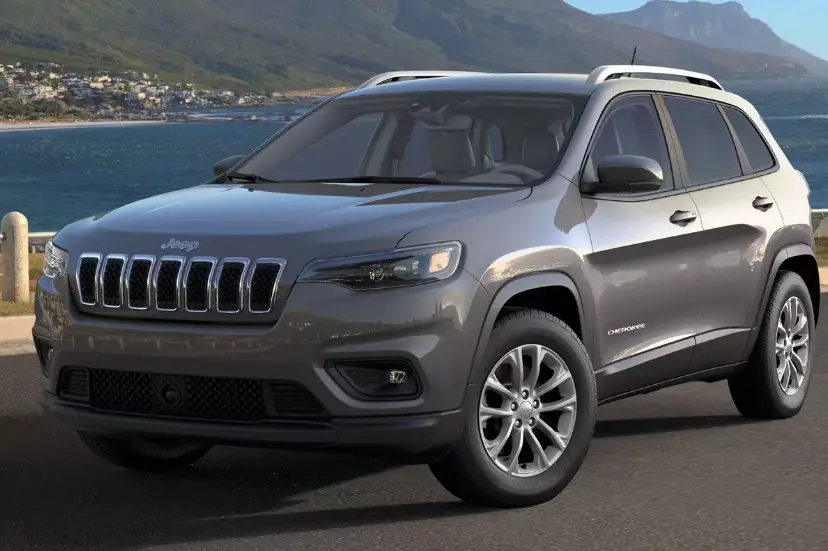

2021 Jeep Cherokee Owner’s Manual
The 2021 Jeep Cherokee is comfortable and off-road capable. From $26,500, it has numerous engine options, a large cabin, improved safety features, and an intuitive entertainment system, making it ideal for city and trail trips.
2023 JEEP CHEROKEE Specs, Price, Features, Mileage (Brochure)
User Guide
STARTING AND OPERATING
STARTING THE ENGINE
Before starting your vehicle, adjust your seat, adjust both inside and outside mirrors, and fasten your seat belts.
WARNING
- When leaving the vehicle, always remove the key fob from the ignition and lock your vehicle. If equipped with Keyless Enter ‘n Go™, always make sure the keyless ignition node is in OFF mode, remove the key fob from the vehicle, and lock the vehicle.
- Never leave children alone in a vehicle, or with access to an unlocked vehicle.
- Allowing children to be in a vehicle unattended is dangerous for a number of reasons. A child or others could be seriously or fatally injured. Children should be warned not to touch the parking brake, brake pedal, or gear selector.
- Do not leave the key fob in or near the vehicle, or in a location accessible to children, and do not leave the ignition of a vehicle equipped with Keyless Enter ‘n Go™ in the ACC or ON/RUN mode. A child could operate power windows, and other controls, or move the vehicle.
Start the engine with the gear selector in the NEUTRAL (N) or PARK (P) position. Apply the brake before shifting to any driving range.
NORMAL STARTING — GASOLINE ENGINE
Press the brake pedal and place the ignition in the START mode and release it when the engine starts. If the engine fails to start within 10 seconds:
- Place the ignition in the OFF mode.
- Wait 10 to 15 seconds.
- Repeat the “Normal Starting” procedure.
NOTE: Only press one pedal at a time while driving the vehicle. The torque performance of the vehicle could be reduced if both pedals are pressed at the same time. If pressure is detected on both pedals simultaneously, a warning message will display in the instrument cluster.
Tip Start Feature
Place the ignition in the START mode and release it as the starter engages. The starter motor will automatically disengage itself once the engine is running. If the engine fails to start, the starter will disengage automatically in 10 seconds. If this occurs:
- Place the ignition in the OFF mode.
- Wait 10 to 15 seconds.
- Repeat the “Normal Starting” procedure.
EXTREME COLD WEATHER (BELOW –20°F OR −29°C)
To ensure reliable starting at these temperatures, the use of an externally powered electric engine block heater (available from an authorized dealer) is recommended.
EXTENDED PARK STARTING
NOTE: Extended Park condition occurs when the vehicle has not been started or driven for at least 30 days.
- Install a battery charger or jumper cables to the battery to ensure a full battery charge during the crank cycle.
- Place the ignition in the START mode and release it when the engine starts.
- If the engine fails to start within 10 seconds, place the ignition in the OFF mode, wait 10 to 15 seconds to allow the starter to cool, then repeat the Extended Park Starting procedure.
- If the engine fails to start after eight attempts, allow the starter to cool for at least 10 minutes, then repeat the procedure.
CAUTION: To prevent damage to the starter, do not crank continuously for more than 10 seconds at a time. Wait 10 to 15 seconds before trying again.
IF THE ENGINE FAILS TO START
WARNING
- Never pour fuel or other flammable liquid into the throttle body air inlet opening in an attempt to start the vehicle. This could result in a flash fire causing serious personal injury.
- Do not attempt to push or tow your vehicle to get it started. Vehicles equipped with an automatic transmission cannot be started this way. Unburned fuel could enter the catalytic converter and once the engine has started, ignite and damage the converter and vehicle.
- If the vehicle has a discharged battery, booster cables may be used to obtain a start from a booster battery or the battery in another vehicle. This type of start can be dangerous if done improperly.
AFTER STARTING
The idle speed is controlled automatically, and it will decrease as the engine warms up.
ENGINE BLOCK HEATER
The engine block heater warms the engine and permits quicker starts in cold weather. Connect the cord to a 110-115 Volt AC electrical outlet with a grounded, three-wire extension cord. For ambient temperatures below 0°F (-18°C), the engine block heater is recommended for at least an hour to have an adequate warming effect on the engine. For ambient temperatures below -20°F (-29°C), the engine block heater is required for at least four hours to have an adequate warming effect on the engine. The engine block heater cord is routed under the hood, behind the driver’s side headlamp. Follow the steps below to properly use the engine block heater:
- Locate the engine block heater cord (behind the driver’s side headlamp).
- Undo the hook-and-loop strap that secures the heater cord in place.
- Pull the cord to the front of the vehicle and plug it into a grounded, three-wire extension cord.
- After the vehicle is running, reattach the cord to the hook-and-loop strap and properly stow away behind the driver’s side headlamp.
NOTE
- The engine block heater cord is a factory-installed option. If your vehicle is not equipped, heater cords are available from an authorized dealer.
- The engine block heater will require 110 Volt AC and 6.5 Amps to activate the heater element.
WARNING: Remember to disconnect the engine block heater cord before driving. Damage to the 110-115 Volt electrical cord could cause electrocution.
ENGINE BREAK-IN RECOMMENDATIONS
A long break-in period is not required for the engine and drivetrain (transmission and axle) in your vehicle. Drive moderately during the first 300 miles (500 km). After the initial 60 miles (100 km), speeds up to 50 or 55 mph (80 or 90 km/h) are desirable. While cruising, brief full-throttle acceleration within the limits of local traffic laws contributes to a good break-in. Wide-open throttle acceleration in low gear can be detrimental and should be avoided. The engine oil installed in the engine at the factory is a high-quality energy-conserving type lubricant. Oil changes should be consistent with anticipated climate conditions under which vehicle operations will occur.
CAUTION: Never use Non-Detergent Oil or Straight Mineral Oil in the engine or damage may result.
NOTE: A new engine may consume some oil during its first few thousand miles (kilometers) of operation. This should be considered a normal part of the break-in and not interpreted as a problem.
PARKING BRAKE
ELECTRIC PARK BRAKE (EPB)
Your vehicle is equipped with an EPB that offers simple operation, and some additional features that make the parking brake more convenient and useful. The parking brake is primarily intended to prevent the vehicle from rolling while parked. Before leaving the vehicle, make sure that the parking brake is applied. Also, be certain to leave the transmission in PARK (P).
You can engage the parking brake in two ways:
- Manually, by applying the EPB switch.
- Automatically, by enabling the Auto Park Brake feature in the customer programmable features.
The EPB switch is located in the center console, behind the gear selector.
EPB Switch
To apply the parking brake manually, pull up on the EPB switch momentarily. You may hear a sound from the back of the vehicle while the parking brake engages. Once the parking brake is fully engaged, the red BRAKE telltale light in the instrument cluster and an indicator on the switch will illuminate. If your foot is on the brake pedal while you apply the parking brake, you may notice a small amount of brake pedal movement. The parking brake can be applied even when the ignition switch is OFF but the BRAKE telltale light will not illuminate. The parking brake can only be released when the ignition is in the ON/RUN mode.
NOTE
- The EPB fault light will illuminate if the EPB switch is held for longer than 90 seconds in either the released or applied position. The light will extinguish upon releasing the switch.
- If the Auto Park Brake feature is enabled, the parking brake will automatically engage whenever the transmission is placed into PARK, while the ignition is turned OFF. If your foot is on the brake pedal, you may notice a small amount of brake pedal movement while the parking brake is engaging.
- The parking brake will release automatically when the ignition is ON, the transmission is in DRIVE (D) or REVERSE (R), and the driver seat belt is buckled.
- To release the parking brake manually, the ignition switch must be in the ON/RUN mode. Put your foot on the brake pedal, then push the EPB switch down momentarily. You may hear a sound from the back of the vehicle while the parking brake disengages. You may also notice a small amount of movement in the brake pedal. Once the parking brake is fully disengaged, the BRAKE telltale light in the instrument cluster and the LED indicator on the switch will extinguish.
- When parking on a hill, it is important to turn the front wheels toward the curb on a downhill grade and away from the curb on an uphill grade. Apply the parking brake before placing the gear selector in PARK, otherwise, the load on the transmission locking mechanism may make it difficult to move the gear selector out of PARK.
Auto Park Brake
The EPB can be programmed to be applied automatically whenever the vehicle is at a standstill and the automatic transmission is placed in PARK, whenever the ignition is turned OFF. Auto Park Brake is enabled and disabled by customer selection through the customer programmable features Ú page 158.
Any single Auto Park Brake application can be bypassed by pushing the EPB switch to the release position while the transmission is placed in PARK.
SafeHold
SafeHold is a safety feature of the EPB System that will engage the parking brake automatically if the vehicle is left unsecured while the ignition is in ON/RUN mode.
For automatic transmissions, the parking brake will automatically engage if all of the following conditions are met:
- The vehicle is at a standstill.
- There is no attempt to press the brake pedal or accelerator pedal.
- The driver seat belt is unbuckled.
- The driver’s door is open.
Useful Links
2024 Jeep Wrangler 4xe Owner’s Manual
2022 Jeep Cherokee Owner’s Manual
2023 JEEP CHEROKEE Specs, Price, Features, Mileage (Brochure)