
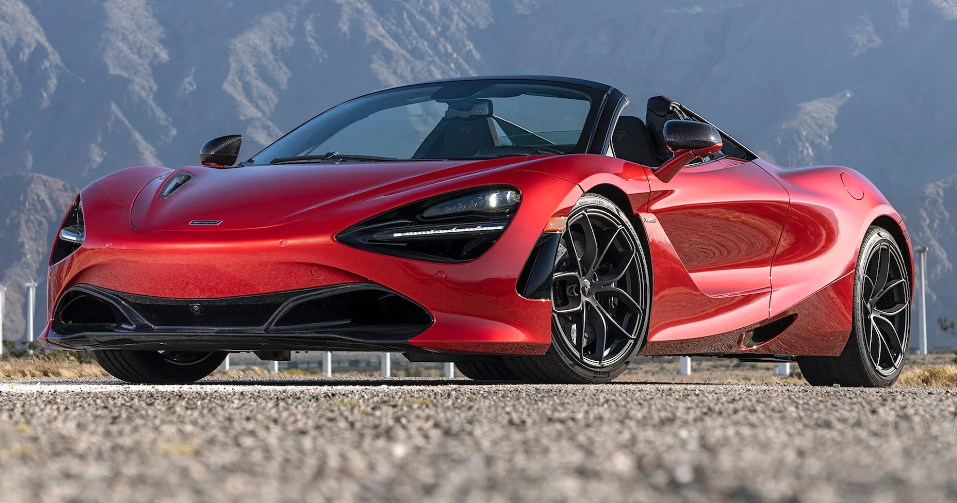

2023 McLaren 720S Specifications and Features Guide
When it comes to mastery in automobile engineering, the 2023 McLaren 720S stands out as the clear winner when it comes to precision, power, and unmatched performance. This amazing car combines cutting-edge technology with classic design elements in a way that redefines what is possible in an automotive masterpiece. It comes from a long history of constant innovation and track-proven knowledge. At the heart of the 720S is a carefully crafted 4.0-litre twin-turbocharged V8 engine that is ready to unleash an exhilarating symphony of power, producing an amazing 710 horsepower and 568 lb-ft of torque that will take it to incredible speeds with ease. The car’s lightweight carbon-fibre chassis and advanced aerodynamic profile give it unmatched agility and handling ability, giving drivers complete trust on the road
2023 McLaren 720S Specs, Price, Features, Mileage and Review
Vehicle Identification
Vehicle identification number (VIN)
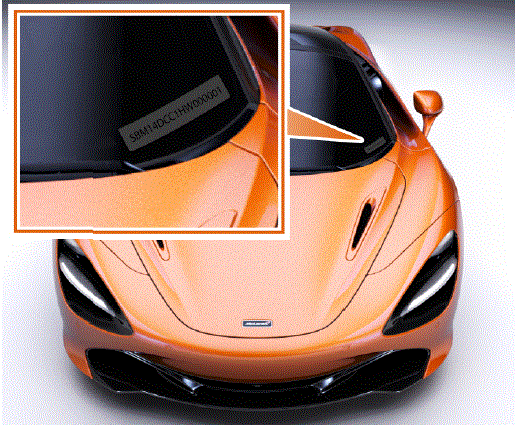
The vehicle identification number can be found on the bottom left-hand corner of the windscreen.
The number can also be found engraved on the body behind the right-hand seat, stamped on a plate at the base of the driver’s side door aperture and viewed in the Vehicle info section on the Folding Driver Display, see Vehicle identification.
VIN plate
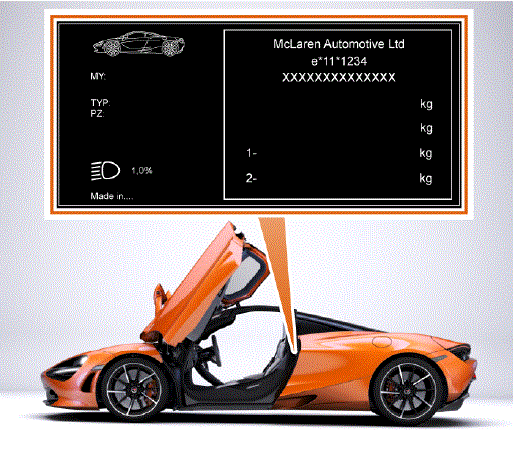
The vehicle identification number plate also contains the following:
- Maximum permitted laden weight
- Maximum permitted laden weight including trailer
- Maximumpermittedfrontaxleladenweight
- Maximum permitted rear axle-laden weight
Data
Overview
This section contains all the necessary technical data for your vehicle and applies to the vehicle’s standard equipment. The data may therefore differ for vehicles with optional equipment. You can obtain further information from your McLaren retailer.
Vehicle operating temperatures
|
Minimum ambient operating temperature |
-20°C (-4°F) |
|
Maximum ambient operating temperature |
+50°C (+122°F) |
NOTE: If the vehicle is used outside the minimum and maximum ambient temperatures, performance degradation may be experienced. McLaren disclaims any liability for the stated engine power not being achieved if the vehicle is being used outside of the stated temperature ranges or being used at altitude.
Engine
|
Engine – 720S Coupe |
|
|
Rated output (kW) @rpm |
537 @ 7,500 |
|
Rated output (PS) @rpm |
720 @ 7,500 |
|
Rated torque (Nm) @rpm |
770 @ 5,500 |
|
Rated torque (lb-ft) @rpm |
568 @ 5,500 |
|
Number of cylinders |
8 |
|
Displacement cm³ |
3,994 |
|
Maximum engine speed (rpm) |
8,500 |
|
Power to weight ratio (PS/tonne) |
561 |
|
Engine – 720S Spider |
|
|
Rated output (kW) @rpm |
530 @ 7,250 |
|
Rated output (PS) @rpm |
720 @ 7,250 |
|
Rated torque (Nm) @rpm |
770 @ 6,500 |
|
Rated torque (lb-ft) @rpm |
568 @ 6,500 |
|
Number of cylinders |
8 |
|
Displacement cm³ |
3,994 |
|
Maximum engine speed (rpm) |
8,500 |
|
Power to weight ratio (PS/tonne) |
540 |
|
Engine – 765LT Coupe |
|
|
Rated output (kW) @rpm |
563 @ 7,500 |
|
Rated output (PS) @rpm |
765 @ 7,500 |
|
Rated torque (Nm) @rpm |
800 @ 5,500 |
|
Rated torque (lb-ft) @rpm |
590 @ 5,500 |
|
Number of cylinders |
8 |
|
Displacement cm³ |
3,994 |
|
Maximum engine speed (rpm) |
8,500 |
|
Power to weight ratio (PS/tonne) |
615 |
|
Engine – 765LT Spider |
|
|
Rated output (kW) @rpm |
563 @ 7,500 |
|
Rated output (PS) @rpm |
765 @ 7,500 |
|
Rated torque (Nm) @rpm |
800 @ 5,500 |
|
Rated torque (lb-ft) @rpm |
590 @ 5,500 |
|
Number of cylinders |
8 |
|
Displacement cm³ |
3,994 |
|
Maximum engine speed (rpm) |
8,500 |
|
Power to weight ratio (PS/tonne) |
592 |
Maximum speeds in each gear
|
720S Coupe and Spider |
|
|
1st gear (mph (km/h)) |
50 (80) |
|
2nd gear (mph (km/h)) |
76 (122) |
|
3rd gear (mph (km/h)) |
105 (169) |
|
4th gear (mph (km/h)) |
136 (218) |
|
5th gear (mph (km/h)) |
173 (278) |
|
6th gear (mph (km/h)) |
212 (340) |
|
7th gear (mph (km/h)) |
197 (317) |
|
765LT Coupe and Spider |
|
|
1st gear (mph (km/h)) |
44 (71) |
|
2nd gear (mph (km/h)) |
67 (108) |
|
3rd gear (mph (km/h)) |
93 (150) |
|
4th gear (mph (km/h)) |
120 (193) |
|
5th gear (mph (km/h)) |
153 (246) |
|
6th gear (mph (km/h)) |
195 (314) |
|
7th gear (mph (km/h)) |
205 (330) |
Gear ratios
|
Gear ratios – 720S Coupe and Spider |
|
|
1st gear |
3.982:1 |
|
2nd gear |
2.612:1 |
|
3rd gear |
1.905:1 |
|
4th gear |
1.479:1 |
|
5th gear |
1.160:1 |
|
6th gear |
0.906:1 |
|
7th gear |
0.686:1 |
|
Final drive |
3.308:1 |
|
Gear ratios – 765LT Coupe and Spider |
|
|
1st gear |
3.982:1 |
|
2nd gear |
2.612:1 |
|
3rd gear |
1.905:1 |
|
4th gear |
1.479:1 |
|
5th gear |
1.160:1 |
|
6th gear |
0.906:1 |
|
7th gear |
0.686:1 |
|
Final drive |
3.727:1 |
Vehicle dimensions
Dimensions – 720S Coupe and Spider

|
A |
Vehicle length |
4,543 mm (14 ft 11 in) |
|
B |
Wheelbase |
2,670 mm (8 ft 10 in) |
|
C |
Rear overhang |
816 mm (2 ft 8 in) |
|
D |
Front overhang |
1,058 mm (3 ft 6 in) |
|
E |
Ground clearance (normal) |
107 mm (4 in) |
|
Ground clearance (vehicle lift) |
134 mm (5 in) |
|
|
F |
Approach angle (normal) |
8.3⁰ |
|
Approach angle (vehicle lift) |
10.4⁰ |
|
|
G |
Departure angle (normal) |
13.3⁰ |
|
Departure angle (vehicle lift) |
12.6⁰ |

|
H |
Vehicle width (doors closed, including mirrors) |
2,161 mm (7 ft 1 in) |
|
I |
Vehicle height (doors closed) – Coupe |
1,196 mm (3 ft 11 in) |
|
Vehicle height (doors closed) – Spider |
1,194 mm (3 ft 11 in) |

|
J |
Vehicle width (doors open at widest point) |
2,809 mm (9 ft 3 in) |
|
K |
Vehicle height (doors open) |
1,953 mm (6 ft 5 in) |
NOTE: All dimensions are approximate.
Dimensions 765LT Coupe and Spider

|
A |
Vehicle length |
4,600 mm (15 ft 1 in) |
|
B |
Wheelbase |
2,670 mm (8 ft 10 in) |
|
C |
Rear overhang |
824 mm (2 ft 8 in) |
|
D |
Front overhang |
1,105 mm (3 ft 8 in) |
|
E |
Ground clearance (normal) |
101 mm (4 in) |
|
Ground clearance (vehicle lift) |
106 mm (4 in) |
|
F |
Approach angle (normal) |
6.93⁰ |
|
Approach angle (vehicle lift) |
8.88⁰ |
|
|
G |
Departure angle (normal) |
12.3⁰ |

|
H |
Vehicle width (doors closed, including mirrors) |
2,161 mm (7 ft 1 in) |
|
I |
Vehicle height (doors closed) – Coupe |
1,159 mm (3 ft 10 in) |

|
J |
Vehicle width (doors open at widest point) |
2,767 mm (9 ft 1 in) 675LT Coupe 3,006 mm (9 ft 10 in) 675LT Spider |
|
K |
Vehicle height (doors open) |
1,947 mm (6 ft 5 in) 675LT Coupe 1,960 mm (6 ft 5 in) 675LT Spider |
NOTE: All dimensions are approximate.
Vehicle weights
|
Weight – 720S Coupe |
|
|
Dry weight (kg (lbs)) |
1,322 (2,920) |
|
Unladen weight (all fluids and 90% fuel) (kg (lbs)) |
1,419 (3,128) |
|
Kerb weight (plus 75 kg driver) (kg (lbs)) |
1,494 (3,294) |
|
Kerb weight distribution (plus 75 kg driver) – front axle (kg (lbs)) |
621 (1,368) |
|
Kerb weight distribution (plus 75 kg driver) – rear axle (kg (lbs)) |
873 (1,925) |
|
Maximum gross vehicle weight(GVW) (kg (lbs)) |
1,690 (3,727) |
|
Maximum gross vehicle weight distribution – front axle (kg (lbs)) |
763 (1,682) |
|
Maximum gross vehicle weight distribution – rear axle (kg (lbs)) |
928 (2,045) |
|
Maximum load – front luggage compartment (kg (lbs)) |
50 (110) |
|
Weight – 720S Spider |
|
|
Dry weight (kg (lbs)) |
1,371 (3,022) |
|
Unladen weight (all fluids and 90% fuel) (kg (lbs)) |
1,468 (3,236) |
|
Kerb weight (plus 75 kg driver) (kg (lbs)) |
1,543 (3,402) |
|
Kerb weight distribution (plus 75 kg driver) – front axle (kg (lbs)) |
658 (1,451) |
|
Kerb weight distribution (plus 75 kg driver) – rear axle (kg (lbs)) |
885 (1,951) |
|
Maximum gross vehicle weight(GVW) (kg (lbs)) |
1,741 (3,838) |
|
Maximum gross vehicle weight distribution – front axle (kg (lbs)) |
807 (1,779) |
|
Maximum gross vehicle weight distribution – rear axle (kg (lbs)) |
934 (2,059) |
|
Maximum load – front luggage compartment (kg (lbs)) |
50 (110) |
|
Weight – 765LT Coupe |
|
|
Dry weight (kg (lbs)) |
1,243 (2,740) |
|
Unladen weight (all fluids and 90% fuel) (kg (lbs)) |
1,339 (2,952) |
|
Kerb weight (plus 75 kg driver) (kg (lbs)) |
1,414 (3,117) |
|
Kerb weight distribution (plus 75 kg driver) – front axle (kg (lbs)) |
594 (1,310) |
|
Kerb weight distribution (plus 75 kg driver) – rear axle (kg (lbs)) |
820 (1,808) |
|
Maximum gross vehicle weight(GVW) (kg (lbs)) |
1,644 (3,624) |
|
Maximum gross vehicle weight distribution – front axle (kg (lbs)) |
751 (1,656) |
|
Maximum gross vehicle weight distribution – rear axle (kg (lbs)) |
893 (1,748) |
|
Maximum load – front luggage compartment (kg (lbs)) |
50 (110) |
|
Weight – 765LT Spider |
|
|
Dry weight (kg (lbs)) |
1,292 (2,848) |
|
Unladen weight (all fluids and 90% fuel) (kg (lbs)) |
1,388 (3,060) |
|
Kerb weight (plus 75 kg driver) (kg (lbs)) |
1,463 (3,225) |
|
Kerb weight distribution (plus 75 kg driver) – front axle (kg (lbs)) |
609 (1,343) |
|
Kerb weight distribution (plus 75 kg driver) – rear axle (kg (lbs)) |
854 (1,883) |
|
Maximum gross vehicle weight(GVW) (kg (lbs)) |
1,690 (3,726) |
|
Maximum gross vehicle weight distribution – front axle (kg (lbs)) |
765 (1,687) |
|
Maximum gross vehicle weight distribution – rear axle (kg (lbs)) |
925 (2,039) |
|
Maximum load – front luggage compartment (kg (lbs)) |
50 (110) |
Wheel and tyre sizes
Wheel sizes
|
Front wheels |
9J x 19 |
|
Rear wheels |
11J x 20 |
Summer tyres
|
Front tyres |
|
|
– Pirelli P Zero™ MC1 |
245/35 R19 |
|
– Pirelli P Zero™ Corsa MC1 |
245/35 R19 |
|
– Pirelli P Zero™ Trofeo R MC2 |
245/35 R19 |
|
Rear tyres |
|
|
– Pirelli P Zero™ MC1 |
305/30 R20 |
|
– Pirelli P Zero™ Corsa MC1 |
305/30 R20 |
|
– Pirelli P Zero™ Trofeo R MC2 |
305/30 R20 |
Winter tyres
|
Front tyres |
|
|
– Pirelli SottoZero™ 2 |
245/35 R19 |
|
Rear tyres |
|
|
– Pirelli SottoZero™ 2 |
295/30 R20 |
Turning circle
|
Turning circle kerb-to-kerb |
12.2 m (40 ft) |
Cold tyre inflation pressures
|
Loading condition |
Front wheels |
Rear wheels |
||
|
Normal use |
Bar |
Psi |
Bar |
Psi |
|
Pirelli P Zero™ |
2.2 |
32 |
2.2 |
32 |
|
Pirelli P Zero™ Corsa |
2.2 |
32 |
2.2 |
32 |
|
Pirelli SottoZero™ |
2.2 |
32 |
2.2 |
32 |
|
Pirelli P Zero™ Trofeo R |
2.0 |
29 |
2.0 |
29 |
|
Loading condition |
Front wheels |
Rear wheels |
||
|
Speeds over 165 mph (270 km/h) |
Bar |
Psi |
Bar |
Psi |
|
Pirelli P Zero™ |
2.7 |
39 |
2.7 |
39 |
|
Pirelli P Zero™ Corsa |
2.7 |
39 |
2.7 |
39 |
|
Loading condition |
Front wheels |
Rear wheels |
||
|
Pirelli P Zero™ Trofeo R |
2.5 |
36 |
2.5 |
36 |
The tyre pressures can also be found on a label on the inside of the fuel filler flap.

NOTE: In some markets, the tyre pressure label is attached to the base of the driver’s side door aperture.
Service Products, Fluids and Capacities
Service products
Service products are fuel, engine oil, coolant and brake fluid. McLaren recommends that you only use products tested and approved for McLaren. Damage resulting from using non-approved service products is not covered by the liability for material defects.
WARNING: When handling, storing and disposing of any service products, please observe the relevant regulations. Failure to do so could endanger people and the environment. Do not allow service products to come into direct contact with your eyes or open wounds. Contact a doctor immediately if any service product is swallowed.
 ENVIRONMENTAL: Dispose of service products in an environmentally responsible manner.
Engine oil

|
Engine oil capacity |
8.0 litres |
McLaren recommends using Gulf Formula Elite 5W-40 (API SP, ACEA C3).
Gulf Formula Elite is an advanced, fully synthetic oil that provides enhanced deposit and wear protection. It also offers protection against possible Low-Speed Pre-Ignition (LSPI) in the latest Turbocharged Gasoline Direct Injection (TGDI) engines.
As per industry standard tests, it can offer up to:
40% more deposit control 1
37% less wear 2
90% better soot handling 3
1 As per industry standard test Seq. IH for API SP
2 As per industry standard test OM646LA for ACEA C3
3 As per industry standard test DV6C for ACEA C3
You may obtain further information from your McLaren retailer.
NOTE: Do not use any lubricant additives. These could lead to increased wear and damage to the mechanical assemblies. Damage caused by additives, that are not approved, is not covered by the McLaren warranty.
Fuel
WARNING: Fuel is highly flammable. Fire, naked flames and smoking are prohibited when handling fuels. Switch off the engine before refuelling.
WARNING: Do not allow fuel to come into contact with skin or clothing. Allowing fuels to come into direct contact with your skin or inhaling fuel vapours is damaging to your health.
For more information about fuel
Fuel tank
|
Total capacity |
60 litres (13.2 UK gal.) |
|
Capacity remaining when amber low-level lamp illuminates |
20 litres (4.4 UK gal.) |
|
Capacity remaining when red low-level lamp illuminates |
11 litres (2.4 UK gal.) |
Coolant
|
Cooling system capacity |
24.5 litres (5.4 UK gal.) |
|
Antifreeze quantity for protection to -20°C (-4°F) |
12.25 litres (2.7 UK gal.) |
The coolant is a mixture of water, antifreeze and corrosion inhibitor. It performs the following functions in the cooling system:
- Antifreeze protection
- Increased efficiency of the cooling system
- Offers anti-corrosion protection
NOTE: Use coolant in all climates, all year round. If coolant is not used, the cooling system will not be sufficiently protected from corrosion and the cooling system efficiency will be reduced.
NOTE: To prevent damage to the engine, only top up with a pre-mixed coolant that provides the desired level of antifreeze protection.
If antifreeze/corrosion inhibitor is present in the correct concentration, the boiling point of the coolant will be around 130°C (266°F). The antifreeze and corrosion inhibitor concentration in the cooling system should be approximately 50% ±5%. This will protect the cooling system against freezing in temperatures of -40°C
(-40°F).
The antifreeze and corrosion inhibitor concentration in the cooling system should not exceed 55%, which provides antifreeze protection down to -45°C (-49°F), as a higher concentration will not dissipate heat as effectively.
If the vehicle is losing coolant, do not drive your vehicle and contact your McLaren retailer.
Power steering fluid
Only use Pentosin CHF202 power steering fluid.
Brake fluid
Only use Pentosin DoT 5.1 brake fluid.
Over time, the brake fluid absorbs moisture from the air, this reduces its boiling point.
WARNING: If the boiling point of the brake fluid is reduced too much, vapour pockets may form in the brake system when the brakes are applied hard (e.g. when driving downhill or track driving) impairing the braking efficiency. Therefore, the brake fluid must be replaced at the recommended service intervals.
FAQs
There are 710 horsepower in the 2023 McLaren 720S.
The 2023 McLaren 720S does have a lightweight carbon fibre Monocage II chassis.
It only takes 2.7 seconds for the 2023 McLaren 720S to go from 0 to 60 mph.
The fastest speed for the 2023 McLaren 720S is 212 miles per hour.
The 2023 McLaren 720S Spider is the type that can be turned into a convertible.
The 2023 McLaren 720S has a smooth 7-speed dual-clutch gearbox.
Yes, the 2023 McLaren 720S has improved aerodynamics that make it faster and more stable.
Yes, the 2023 McLaren 720S does have different driving modes that can be changed to fit different tastes and road conditions.
The 2023 McLaren 720S has modern safety features like airbags, traction control, and anti-lock brakes (ABS).
Yes, the 2023 McLaren 720S is made of lightweight materials to give it the best speed and handling.
The 2023 McLaren 720S is very precise and easy to drive, which makes it a strong contender on the track.
Yes, the 2023 McLaren 720S has cutting-edge technology that makes driving it very exciting.
The fuel economy is very good for the 2023 McLaren 720S, especially given how fast it is.
Yes, the 2023 McLaren 720S’s interior does feel luxurious, with high-quality materials and advanced entertainment features.
Yes, the 2023 McLaren 720S has a lot of choices for customisation so that the car can fit a person’s tastes and preferences.
Useful Links
View Full PDF: 2023 McLaren 720S Owner’s Manual|Auto User Guide
2023 McLaren 720S Specs, Price, Features, Mileage and Review