
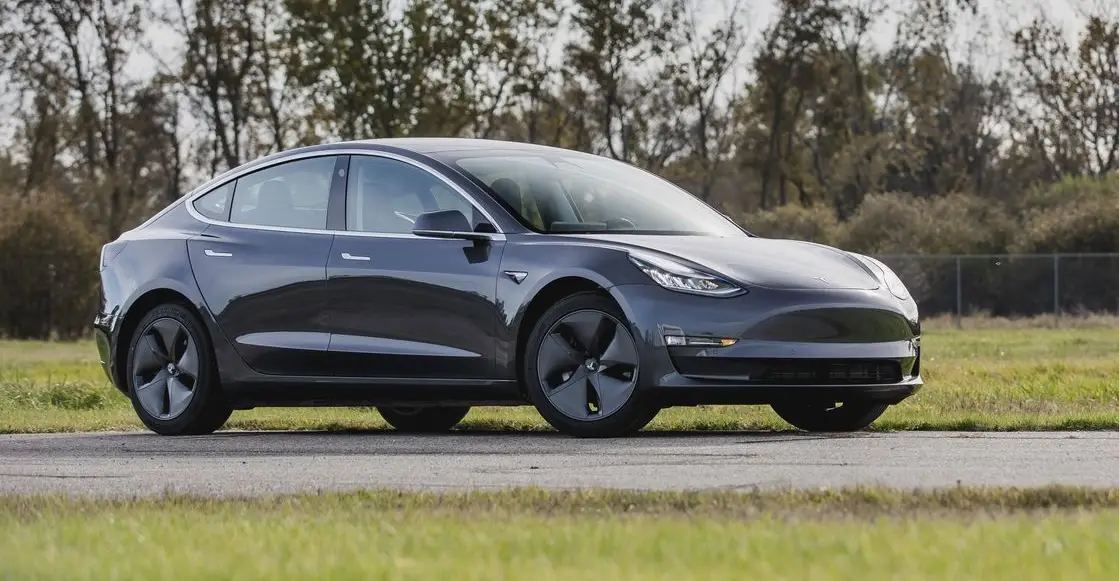

2020 Tesla Model 3 Specifications User Guide
The 2020 Tesla Model 3 has a 353-mile range, fast acceleration, enhanced autopilot, and a minimalist cabin. Its streamlined design blends performance, efficiency, and cutting-edge technology.
2023 Tesla Model 3 Specs, Price, Features, Mileage and Review
Identification Labels
Vehicle Identification Number
You can find the VIN at the following locations:
- Touch the Tesla “T” at the top center of the touchscreen. The popup window displays the VIN.
- Stamped on a plate located at the top of the dashboard. Can be seen by looking through the windshield.

- Printed on the Vehicle Certification label, located on the door pillar. Can be seen when the driver’s door is open.

Emission Control Label
The emission control label is located on the opening face of the rear trunk.

Vehicle Loading
Load Capacity Labeling
It is important to understand how much weight your Model 3 can safely carry. This weight is called the vehicle capacity weight and includes the weight of all occupants, cargo and any additional equipment added to your Model 3 since it was manufactured.
Two labels attached to Model 3 indicate how much weight Model 3 can safely carry.
Both labels are visible on the door pillar when the front door is open.
Note: If your Model 3 is fitted with Tesla accessory wheels or tires, your Model 3 may include an additional label indicating that load capacity may differ from what is stated on the label. If this is the case, instead of referring to the label, refer to the Owner’s Manual. See Accessory Wheels and Tires.

- Tire and Loading Information Label
- Vehicle Certification Label
Warning: Overloading Model 3 has an adverse effect on braking and handling, which can compromise your safety or cause damage.
Caution: Never load more than 55 lbs (25 kg) in the front trunk. Doing so can cause damage.
Caution: Never load more than 130 lbs (60 kg) on the rear load floor (above the lower trunk compartment) or more than 285 lbs (130 kg) in the lower trunk compartment. Doing so can cause damage.
Caution: Never store large amounts of liquid in Model 3. A significant spill can cause electrical components to malfunction.
Tire and Loading Information Label
The Tire and Loading Information label provides:
- The maximum number of occupant seating positions.
- The maximum vehicle capacity weight.
- The size of the original tires.
- The cold inflation pressures for the original front and rear tires. These pressures are recommended to optimize ride and handling characteristics.

Never change this label, even if you use different tires in the future.
Note: If Model 3 is loaded to its full capacity, double check all tires to ensure they are inflated to their recommended pressure levels.
Vehicle Certification Label
The Vehicle Certification label provides:
- GVWR – Gross Vehicle Weight Rating. The maximum allowable total mass of Model 3. This is calculated as the weight of Model 3, all passengers, fluids, and cargo.
- GAWR FRT and GAWR RR – Gross Axle Weight Rating for the front and rear axles. The GAWR is the maximum distributed weight that each axle can support.
United States:

Canada:

Caution: To prevent damage, never load Model 3 so that it is heavier than GVWR or exceeds the individual GAWR weights.
Calculating Load Limits
- Locate the statement “The combined weight of occupants and cargo should never exceed XXX lbs or XXX kg” on the “Tire and Loading Information” label.
- Determine the combined weight of all occupants that will ride in the vehicle.
- Subtract the combined weight of the occupants from XXX lbs or XXX kg (see Step 1).
- The resulting figure equals the available cargo load capacity. For example, if the “XXX” amount equals 1400 lbs (635 kg) and there will be five 150 lb (68 kg) passengers in the vehicle, the amount of available cargo capacity is 650 lbs (1400 ‑ 750 (5 x 150) = 650 lbs) or 295 kg (635 ‑ 340 (5 x 68) = 295 kg).
- Determine the combined cargo weight being loaded on the vehicle. That weight must not exceed the available cargo load capacity calculated in Step 4.
Warning: Trunks are the preferred places to carry objects. In a collision, or during hard braking and sharp turns, loose items in the cabin could injure occupants.
Example Load Limit Calculations
How much cargo Model 3 can carry depends on the number and weight of passengers. The following calculated load limit examples assume passengers weigh 150 lbs (68 kg). If passengers weigh more or less, available cargo weight decreases or increases respectively.
Driver and one passenger
| Description | Total |
| Vehicle capacity weight | 954 lbs (433 kg) |
| Subtract occupant weight (2 x 150 lbs/68 kg) | 300 lbs (136 kg) |
| Available cargo weight | 654 lbs (297 kg) |
Driver and four passengers
| Description | Total |
| Vehicle capacity weight | 954 lbs (433 kg) |
| Subtract occupant weight (5 x 150 lbs/68 kg) | 750 lbs (340 kg) |
| Available cargo weight | 204 lbs (93 kg) |
The cargo weight should be distributed between the front and rear trunks.
- Caution: Do not exceed the maximum front trunk load weight of 55 lbs (25 kg).
- Caution: Never load more than 130 lbs (60 kg) on the rear load floor (above the lower trunk compartment) or more than 285 lbs (130 kg) in the lower trunk compartment. Doing so can cause damage.
Towing a Trailer
- Warning: Do not use Model 3 for towing purposes. Model 3 does not currently support towing. Towing can cause damage and increase the risk of a collision.
- Caution: Using Model 3 for towing before Tesla-approved towing components and accessories are available may void the warranty.
Roof Racks
Model 3 supports the use of Tesla-approved roof racks using a Tesla mounting accessory. To install roof racks, you must use this accessory and you must use only roof rack systems that have been approved by Tesla (see Parts and Accessories). Failure to do so can cause significant damage.
Dimensions and Weights
Exterior Dimensions

| A | Overall Length | 184.8 in | 4,694 mm |
| B | Overall Width (including mirrors) Overall Width (including folded mirrors) Overall Width (excluding mirrors) |
82.2 in 76.1 in 72.8 in |
2,088 mm 1,933 mm 1,849 mm |
| C | Overall Height – coil suspension | 56.8 in | 1,443 mm |
| D | Wheel Base | 113.2 in | 2,875 mm |
| E | Overhang – Front | 33 in | 841 mm |
| F | Overhang – Rear | 39 in | 978 mm |
| G | Ground Clearance – coil suspension | 5.5 in | 140 mm |
| H | Track – Front Track – Rear | 62.2 in 62.2 in |
1,580 mm 1,580 mm |
| *Values are approximate. Dimensions can vary depending on a vehicle’s options and various other factors. | |||
Interior Dimensions
| Head Room (Premium Package) | Front Rear | 40.3 in 37.7 in |
1,024 mm 958 mm |
| Leg Room | Front Rear | 42.7 in 35.2 in |
1,085 mm 894 mm |
| Shoulder Room | Front Rear | 56.3 in 54 in | 1,430 mm 1,372 mm |
| Hip Room | Front Rear | 53.4 in 52.4 in |
1,356 mm 1,331 mm |
Cargo Volume
- Total enclosed cargo volume : 15 cu ft (425 L)
Weights
| Curb Weight* Standard Plus Battery, Single Motor | 3,552 lbs | 1,611 kg |
| Curb Weight* Mid-Range Battery, Single Motor | 3,686 lbs | 1,672 kg |
| Curb Weight* Long Range Battery, Single Motor | 3,805 lbs | 1,726 kg |
| Curb Weight* Long Range Battery, Dual Motor | 4,072 lbs | 1,847 kg |
| Curb Weight* Long Range Battery, Performance Dual Motor | 4100 lbs | 1,860 kg |
| GVWR** Standard Plus Battery, Single Motor | 4,542 lbs | 2,060 kg |
| GVWR** Mid-Range Battery, Single Motor | 4,687 lbs | 2,126 kg |
| GVWR** Long Range Battery, Single Motor | 4,806 lbs | 2,180 kg |
| GVWR** Long Range Battery, Dual Motor | 4,993 lbs | 2,265 kg |
| GVWR** Long Range Battery, Performance Dual Motor | 5,073 lbs | 2,301 kg |
| Gross Vehicle Weight Distribution – Single Motor | Front: 44% | Rear: 56% |
| Gross Vehicle Weight Distribution – Dual Motor | Front: 46% | Rear: 54% |
| Gross Axle Weight Rating – Front | 2,447 lbs | 1,110 kg |
| Gross Axle Weight Rating – Rear | 2,771 lbs | 1,257 kg |
| Towing Capacity | Towing is not permissible | |
| Curb Weight = weight of the vehicle with correct fluid levels, no occupants and no cargo GVWR = Gross Vehicle Weight RatingNote: Values are approximate. Weights can vary depending on a vehicle’s options. |
||
Subsystems
Transmission
| Type | Single speed fixed gear |
| Gearbox Ratio | 9:1 |
Steering
| Type | Rack and pinion with electronic power steering, speed sensitive |
| Number of turns lock to lock | 2.00 |
| Turning Circle (curb to curb) | 38.8 ft (11.8 m) |
Brakes
| Type | 4-wheel anti-lock braking system (ABS) with Electronic Brake Force Distribution, Integrated Advanced Stability Control and Electronic Accelerator pedal actuated regenerative braking system |
| Calipers | Front: Four piston fixed Rear: Integrated Electronic Parking Brake Sliding |
| Rotor Diameter (ventilated) | Front (non-Performance): 12.6″/320 mm Front (Performance): 13.98″/355 mm Rear (non-Performance): 13.2″/335 mm Rear (Performance): 13.2”/335 mm |
| Front Rotor thickness | New: 0.98″/25 mm Service limit: 0.91”/23 mm |
| Rear Rotor thickness | New: 0.79″/20 mm Service limit: 0.71”/18 mm |
| Non-Performance Front Brake Pad Thickness (excluding back plate) | New: 0.393″/10 mm Service limit: 0.110″/2.8 mm |
| Non-Performance Rear Brake Pad Thickness (excluding back plate) | New: 0.354″/9 mm Service limit: 0.078″/2 mm |
| Performance Front Brake Pad Thickness (excluding back plate) | New: 0.393″/10 mm Service limit: 0.085″/2.15 mm |
| Performance Rear Brake Pad Thickness (excluding back plate) | New: 0.393″/10 mm Service limit: 0.071″/1.8 mm |
| Parking brake | Electrically actuated parking brake integrated into rear caliper |
Suspension
| Front | Independent, double wishbone, coil spring/telescopic damper, sway bar |
| Rear | Independent, multi-link, coil spring/ telescopic damper |
Battery – 12V
| Rating | 33 amp hour or higher |
| Voltage and Polarity | 12V negative (-) ground |
Battery – High Voltage
| Type | Liquid-cooled lithium ion (Li-ion) |
| Temperature Range | Do not expose Model 3 to ambient temperatures above 140° F (60° C) or below -22° F (-30° C) for more than 24 hours at a time. |
Useful Links:
View Full PDF: 2020 Tesla Model 3 |Auto User Guide
2023 Tesla Model 3 Specs, Price, Features, Mileage and Review