


2020 Toyota RAV4 Hybrid Owner’s Manual
The 2020 Toyota RAV4 Hybrid is a big step forward in how hybrid SUVs have changed over time. By combining the flexible design of the popular RAV4 with a hybrid powertrain, this car gets the essence of eco-friendly performance without sacrificing capability. With a gas engine and electric power, the RAV4 Hybrid gets great gas mileage and is fun to drive. Its sleek exterior design, high-tech features, and roomy interior make it appealing to both drivers who care about the environment and those who want a useful and stylish car. As Toyota’s commitment to sustainability grows, the 2020 RAV4 Hybrid stands out as a compelling choice in the crossover market. It strikes a good mix between efficiency, innovation, and day-to-day utility.
Safety Connect LED light Indicators
When the power switch is turned to ON, the red indicator light comes on for 2 seconds then turns off. Afterward, the green indicator light comes on, indicat-ing that the service is active.
The following indicator light pat-terns indicate specific system usage conditions:
- Green indicator light on = Active service
- Green indicator light flashing = Safety Connect call in pro-cess
- Red indicator light (except at vehicle start-up) = System malfunction (contact your Toy-ota dealer)
- No indicator light (off) = Safety Connect service not active
Safety Connect services
Automatic Collision Notifi-cation
In case of either airbag deploy-ment or severe rear-end colli-sion, the system is designed to automatically call the response center. The responding agent receives the vehicle’s location and attempts to speak with the vehicle occupants to assess the level of emergency. If the occupants are unable to communi-cate, the agent automatically treats the call as an emergency, contacts the nearest emer-gency services provider to describe the situation, and requests that assistance be sent to the location.
Stolen Vehicle Location
If your vehicle is stolen, Safety Connect can work with local authorities to assist them in locating and recovering the vehicle. After filing a police report, call the Customer Experi-ence Center at 1-800-331-4331 in the United States, 1-877-855-8377 in Puerto Rico or 1-888-869-6828 in Canada, and follow the prompts for Safety Connect to initiate this service. In addition to assisting law enforcement with recovery of a stolen vehicle, Safety-Connect-equipped vehicle location data may, under certain circum-stances, be shared with third parties to locate your vehicle. Further information is available at Toyota.com in the United States, Toyotapr.com in Puerto Rico and Toyota.ca in Canada.
Emergency Assistance But-ton (“SOS”)
In the event of an emergency on the road, push the “SOS” button to reach the Safety Connect response center. The answer-ing agent will determine your vehicle’s location, assess the emergency, and dispatch the necessary assistance required.
If you accidentally press the “SOS” button, tell the response-center agent that you are not experiencing an emergency.
Enhanced Roadside Assis-tance
Enhanced Roadside Assistance adds GPS data to the already included warranty-based Toyota roadside service. Subscribers can press the “SOS” button to reach a Safety Connect response-center agent, who can help with a wide range of needs, such as: towing, flat tire, fuel delivery, etc. For a description of the Enhanced Roadside Assistance services and their limitations, please see the Safety Connect Terms and Conditions, which are available at Toyota.com in the United States, Toyotapr.com in Puerto Rico and Toyota.ca in Canada.
Safety information for Safety Connect
Important! Read this informa-tion before using Safety Con-nect.
Exposure to radio fre-quency signals
The Safety Connect system installed in your vehicle is a low-power radio transmitter and receiver. It receives and also sends out radio frequency (RF) signals. In August 1996, the Federal Communications Commission (FCC) adopted RF exposure guidelines with safety levels for mobile wireless phones. Those guidelines are consistent with the safety standards previously set by the following U.S. and international standards bodies.
- ANSI (American National Standards Institute) C95.1 [1992]
- NCRP (National Council on Radiation Protection and Measurement) Report 86 [1986]
- ICNIRP (International Com-mission on Non-Ionizing Radi-ation Protection) [1996]
Those standards were based on comprehensive and periodic evaluations of the relevant sci-entific literature. Over 120 scien-tists, engineers, and physicians from universities, and govern-ment health agencies and industries reviewed the avail-able body of research to develop the ANSI Standard (C95.1). The design of Safety Connect complies with the FCC guide-lines in addition to those stan-dards.
Hybrid system features
Your vehicle is a hybrid vehicle. It has characteristics different from conventional vehicles. Be sure you are closely familiar with the characteristics of your vehicle, and operate it with care. The hybrid system combines the use of a gasoline engine and an electric motor (traction motor) according to driving condi-tions, improving fuel efficiency and reducing exhaust emis-sions.
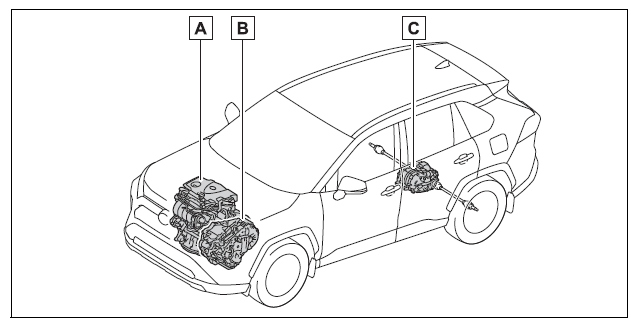
System components
The illustration is an example for explanation and may differ from the actual item.
- Gasoline engine
- Front electric motor (traction motor)
- Rear electric motor (traction motor)
When stopped/during start off
The gasoline engine stops* when the vehicle is stopped. During start off, the electric motor (traction motor) drives the vehicle. At slow speeds or when traveling down a gentle slope, the engine is stopped* and the electric motor (traction motor) is used. When the shift lever is in N, the hybrid battery (traction battery) is not being charged. *: When the hybrid battery (traction *: When the hybrid battery (traction
- During normal driving
The gasoline engine is predominantly used. The electric motor (traction motor) charges the hybrid battery (traction battery) as necessary. - When accelerating sharply
When the accelerator pedal is depressed heavily, the power of the hybrid battery (traction bat-tery) is added to that of the gas-oline engine via the electric motor (traction motor). - When braking (regenerative braking)
The wheels operate the electric motor (traction motor) as a power generator, and the hybrid battery (traction battery) is charged. - Regenerative braking
In the following situations, kinetic energy is converted to electric energy and deceleration force can be obtained in conjunction with the recharging of the hybrid battery(traction battery).- The accelerator pedal is released while driving with the shift lever in D or S.
- The brake pedal is depressed while driving with the shift lever in D or S
- EV indicator
The EV indicator comes on when the vehicle is driven using only the electric motor (traction motor) or the gasoline engine is stopped. The on/off operation of the EV indicator can be changed. (P.108)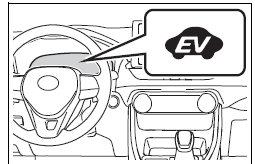
- Conditions in which the gaso-line engine may not stop
The gasoline engine starts and stops automatically. However, it may not stop automatically in the following conditions*:- During gasoline engine warm-up
- During hybrid battery (traction bat-tery) charging
- When the temperature of the hybrid battery (traction battery) is high or low
- When the heater is switched on *: Depending on the circumstances, the gasoline engine may also not stop automatically in other situa-tions.
- Charging the hybrid battery (traction battery)
As the gasoline engine charges the hybrid battery (traction battery), the battery does not need to be charged from an outside source. However, if the vehicle is left parked for a long time the hybrid battery (traction bat-tery) will slowly discharge. For this reason, be sure to drive the vehicle at least once every few months for at least 30 minutes or 10 miles (16 km). If the hybrid battery (traction battery) becomes fully discharged and you are unable to start the hybrid system, contact your Toyota dealer. - After the 12-volt battery has discharged or when the terminal has been removed and installed during exchange, etc.
The gasoline engine may not stop even if the vehicle is being driven by the hybrid battery (traction battery). If this continues for a few days, con-tact your Toyota dealer. - Sounds and vibrations specific to a hybrid vehicle
There may be no engine sound or vibration even though the vehicle is able to move with the “READY” indi-cator is illuminated. For safety, make sure to shift the shift lever to P and apply the parking brake when parked.
The following sounds or vibrations may occur when the hybrid system is operating and are not a malfunction:- Motor sounds may be heard from the engine compartment.
- Sounds may be heard from the hybrid battery (traction battery) under the rear seats when the hybrid system starts or stops.
- Relay operating sounds such as a snap or soft clank will be emitted from the hybrid battery (traction battery), under the rear seats, when the hybrid system is started or stopped.
- Sounds from the hybrid system may be heard when the back door is open.
- Sounds may be heard from the transmission when the gasoline engine starts or stops, when driv-ing at low speeds, or during idling.
- Engine sounds may be heard when accelerating sharply.
- Sounds may be heard due to regenerative braking when the brake pedal is depressed or as the accelerator pedal is released.
- Vibration may be felt when the gasoline engine starts or stops.
- Cooling fan sounds may be heard from the air intake vent under the rear seat.
- Maintenance, repair, recycling, and disposal
Contact your Toyota dealer regard-ing maintenance, repair, recycling and disposal. Do not dispose of the vehicle yourself.
Vehicle proximity notification system
When driving with the gasoline engine stopped, a sound, which changes in accordance with the driving speed, will be played in order to warn people nearby of the vehicle’s approach. The sound will stop when the vehicle speed exceeds approximately 22 mph (35 km/h).
- Vehicle proximity notification system
In the following cases, the vehicle proximity notification system may be difficult for surrounding people to hear. -
- In very noisy areas
- In the wind or the rain
Also, as the vehicle proximity notifi-cation system is installed on the front of the vehicle, it may be more difficult to hear from the rear of the vehicle compared to the front.
- If “Proximity Notification Sys-tem Malfunction Visit Your Dealer” is displayed on the multi-information display
The system may be malfunctioning. Have the vehicle inspected by your Toyota dealer.
FAQ
The 2020 Toyota RAV4 Hybrid is a hybrid version of the popular RAV4 SUV, featuring a combination of a gasoline engine and electric motors for improved fuel efficiency and reduced emissions.
The 2020 RAV4 Hybrid combines a 2.5-liter four-cylinder gasoline engine with electric motors, delivering power to both the front and rear wheels for enhanced traction.
The fuel economy of the 2020 RAV4 Hybrid varies based on factors like driving conditions and trim level, but it generally offers significantly better mileage compared to the non-hybrid RAV4 models.
The RAV4 Hybrid’s all-wheel drive is achieved through an electric motor powering the rear wheels when additional traction is needed, providing improved stability in various conditions.
No, the 2020 RAV4 Hybrid is not a plug-in hybrid. It charges its battery primarily through regenerative braking and the gasoline engine.
The 2020 RAV4 Hybrid was offered in multiple trim levels, including LE Hybrid, XLE Hybrid, XSE Hybrid, and Limited Hybrid.
The 2020 RAV4 Hybrid includes features like Toyota Safety Sense, a suite of advanced driver assistance systems, touchscreen infotainment, available leather upholstery, and more.
The cargo space in the 2020 RAV4 Hybrid is quite generous, with around 37.5 cubic feet behind the rear seats and approximately 69.8 cubic feet with the rear seats folded down.
The RAV4 Hybrid’s all-wheel drive system and higher ground clearance make it capable of handling light off-road trails and challenging conditions with confidence.
Yes, the 2020 RAV4 Hybrid has a towing capacity, though it’s more limited compared to some non-hybrid SUVs. It’s suitable for towing smaller trailers or lightweight loads.
Toyota typically offers a three-year/36,000-mile basic warranty and an eight-year/100,000-mile warranty for the hybrid system components.
Yes, Toyota provides a warranty for the hybrid battery in the 2020 RAV4 Hybrid, usually covering it for eight years/100,000 miles.
The 2020 RAV4 Hybrid often received high safety ratings from organizations like the National Highway Traffic Safety Administration (NHTSA) and the Insurance Institute for Highway Safety (IIHS).
Yes, many 2020 RAV4 Hybrid trims offer standard Apple CarPlay and Android Auto integration for seamless smartphone connectivity.
The RAV4 Hybrid generally has a higher starting price than the non-hybrid RAV4 due to its advanced hybrid technology, but it often offers greater fuel efficiency and eco-friendly benefits.
Useful Link
2021 Toyota RAV4 Owner’s Manual
2021 Toyota RAV4 Hybrid Owner’s Manual
2023 Toyota RAV4 Specs, Price, Features, Milage (brochure)
Related Articles:
2023 Toyota Highlander Specs, Price, Features, and Mileage (Brochure)
2023 Toyota BZ4x Specs, Price, Features, and Mileage (Brochure)
2023 Toyota Crown Specs, Price, Features, and Mileage (Brochure)
2023 Toyota Camry Specs, Price, Features and Mileage (Brochure)