

2025 Audi Q6 e-tron Seats and Seat Belts User Guide
This guide will help you comprehend the 2025 Audi Q6 e-tron seats and seat belts, which are designed for great comfort and safety. Understand how quality materials, adjustable seating, and superior restraint systems improve each drive.
Sitting correctly and safely
MAINTAINING THE CORRECT SEATING POSITION
Safety information about seating positions
As the driver, you are responsible for making sure each person in the vehicle is sitting correctly in their seat and maintaining this correct seating position while driving. Make sure that:
- Each person in the vehicle has adjusted their seat correctly
- The steering wheel is adjusted correctly
- The mirrors are adjusted so that there is a sufficient view of the area around the vehicle
- Each person in the vehicle has adjusted their head restraint correctly
- Each person in the vehicle has adjusted their safety belt correctly
- The activation status of the front passenger’s airbag is suitable for the person in the front passenger’s seat
- Children are secured in suitable child safety seats that are secured to appropriate vehicle seats. Read and observe the important safety information about the use of child safety seats on the front passenger’s seat A\in General information on
Examples of incorrect seating positions
Safety belts can only provide optimal protection when they are routed correctly. Incorrect seating positions significantly reduce the protective functions of the safety belts and increase the risk of injury due to incorrect belt routing.
The following list includes examples of seating positions that could be dangerous for all vehicle occupants. This is not a complete list. Audi would simply like to increase your awareness of the topic.
The following points apply when the vehicle is in motion:
- Never stand inside the vehicle.
- Never stand on the seats.
- Never kneel on the seats.
- Never tilt your backrest too far back.
- Never lean against the instrument panel.
- Never lie down on the rear bench seat.
- Never sit only on the front section of the seat.
- Never sit sideways on the seat.
- Never lean against the window.
- Never place your feet out of the window.
- Never place your feet on the instrument panel.
- Never place your feet on the seat cushion.
- Never ride in the footwell.
- Never sit on the armrests.
- Never drive or ride in a seat without fastening your safety belt.
- Never ride in the luggage compartment.
Warning
Incorrect seating positions, failure to wear a safety belt, or being too close to an airbag increase the risk of serious or fatal injury to vehicle occupants, especially if the airbags deploy and come into contact with occupants who are not seated correctly. Note the important information and warnings in the chapters for the topics given above.
Tips
- Save your seat profile. This allows you to access your personal seat profile quickly and easily at any time.
- If you or other passengers in the vehicle have physical limitations that prevent sitting in a correct position, modifications to the vehicle may be necessary. For more information, contact an authorized Audi dealer or authorized Audi Service Facility, or call Audi customer support at 1-800-822-2834.
Front seats
General information
Make sure that:
- You can press the pedals down completely while your legs are slightly bent.
- The distance between your upper body and the steering wheel or instrument panel is at least 10 inches (25 cm).
- The distance between your knees and the instrument panel is at least 4 inches (10 cm).
- Your thighs are lightly supported by the front surface of the seat.
- The backrest is in an upright position and the back of the person seated is resting against it.
- You have a sufficient view of the area around the vehicle.
- You have a clear view of the instrument cluster, indicator lights, and the head-up display*.
Seat settings menu: quick access
This applies to vehicles with seat settings in the MMI You press on the image of the driver’s or front passenger’s seat in the climate control system menu you will go directly to the seat settings for that seat.
Warning
- If you are too close to the steering wheel or instrument panel, the airbag system cannot provide optimal protection, which increases the risk of injury and death.
- To reduce the risk of injury to the driver in the event of sudden braking manoeuvres or accidents, never drive with the backrest reclined very far. The airbag system and safety belts can only provide optimal prote when the backrest is in an upright position and the driver is wearing the safety belt correctly. If the backrest is angled back too far, the safety belt can shift to soft areas of the body, such as the stomach, which increases the risk of injury.
- To reduce the risk of an accident, only adjust the seats when the vehicle is stationary.
- Be careful when adjusting the seat. Lack of control or attention when adjusting can result in injuries due to pinching for vehicle occupants both in the front seats and rear seats.
- Never place objects in the driver’s footwell. Objects could shift and enter the area around the pedals, which could prevent you from using them. You would then be unable to use the pedals if sudden driving or braking manoeuvres were needed, which increases the risk of an accident.
- Make sure that the floor mats are always securely attached.
- To reduce the risk of an accident, never place additional floor mats or other floor covers over the installed floor mats, because this reduces the pedal’s range of motion and can impair pedal operation.
- To reduce the risk of injury, never place your feet on the instrument panel, out of the window, or on the seat surfaces. This also applies to persons in the rear seats.
Note
To reduce the risk of damage, be very careful when adjusting the seat to make sure the head restraints do not come into contact with the roof.
Tips
At the same time, only move the respective seat using the controls.
Adjusting the front seats
 You can adjust the basic settings using the buttons. The settings depend on the vehicle equipment.
Adjusting the seat position
- To move the seat forward or backwards, push the button forward or backward.
- To adjust the seat upward or downward, push the rear section of the button upward or downward.
- To adjust the seat surface, press the front part of the button upward or downward.
Adjusting the backrests
- To move the backrest forward or backwards, press the but@t) footwear d or backward.
Adjusting the lumbar support
- To adjust the lumbar support, press the button @in the desired direction.
Massage function
Switching the massage function on or off . Setting the massage type and intensity
WARNING
The power front seats can also be adjusted when the ignition is switched off. To reduce the risk of injury, children should never be left unattended in the vehicle.
Seat function
Operating the front seat massage function
- Press the button on the front seat to turn the massage function on or off.
Using elevated entry
Elevated entry makes it easier to enter or exit the vehicle.
You can turn elevated entry on or off and adjust its settings in the Vehicle menu.
Information about the front center armrest
The front center armrest is located between the front seats.
Adjusting the center armrest
The settings depend on the vehicle equipment.
- To raise the center armrest when it is engaged in the lowest starting position, press the but-ton and lift the center armrest.
- To adjust the angle, raise the center armrest in stages from a position that is not engaged.
- To bring the center armrest back into the start-ing position, raise it out of the top level and fold it back down.
WARNING
- In certain positions, the front center arm-rest can interfere with the driver’s arm movement, which increases the risk of in-jury.
- Applies to: center armrest with button or loop: Loose objects can be thrown around the vehicle interior during sudden driving or braking maneuvers, which increases the risk of an accident. Store objects securely while driving.
Operating the memory function
Introduction
Seat profiles can be stored and recalled using the memory function. Depending on vehicle equip-ment, the seat profiles can store various settings, such as the position of the driver’s seat and the exterior mirrors.
The memory function buttons are located in the door trim panel.
The settings depend on the vehicle equipment.
Storing a seat profile
- Push one of the numbered memory buttons. A tone confirms that the settings were stored.
Recalling a seat profile
- Press one of the numbered memory buttons and follow any instructions given by the sys-tem.
WARNING
- To reduce the risk of an accident, the seat setting can only be recalled when the vehicle is stationary.
- To reduce the risk of injuries such as pinch-ing, each adjustment operation in a stored setting can be interrupted by pressing any seat adjustment button on the seat being adjusted.
Steering wheel
Safety information about the steering wheel
Make sure that:
- The distance between your upper body and the steering wheel is at least 10 inches (25 cm).
- Your arms are bent slightly at the elbows.
- You have a sufficient view of the area around the vehicle and you have a clear view of the instrument cluster and head-up display*.
- You are always holding the steering wheel with both hands on the outer edge at the sides (9:00 and 3:00 position) when driving.
Warning
- To reduce the risk of an accident, make sure the steering wheel is adjusted correctly and cannot be moved out of position before you start to drive.
- If you are too close to the steering wheel, the driver’s airbag cannot provide optimal protection, which increases the risk of injury or fatality.
- Never hold the steering wheel in the noon position or in any other way, such as holding the centre of the steering wheel. Otherwise, your arms, hands, and head could be injured if the driver’s airbag deploys.
Adjusting the steering wheel position manually

- Pull the lever in the direction of the arrow.
- Bring the steering wheel into the desired posi-tion.
- Push the lever all the way up until it engages.
WARNING
- To reduce the risk of an accident, only adjust the steering wheel before you start driving.
- Push the lever upward firmly so that the steering wheel position does not change un-intentionally while driving, which would in-crease the risk of an accident.
Power steering wheel position adjustment The power adjustment can be used to move the steering wheel up and down, and forward and back.
- To adjust the steering wheel, press the button in the direction in which you would like the steering wheel to move.
The steering wheel can also be adjusted when the vehicle is turned off.
Head restraints
Safety information about the head restraints
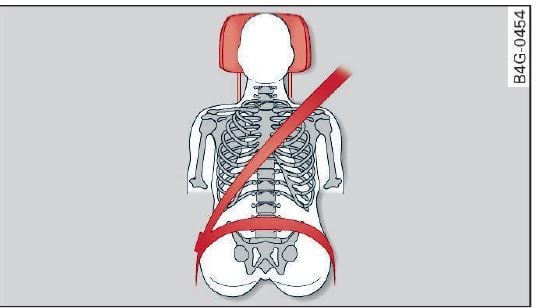 Make sure that:
- The upper edge of the head restraint is as even as possible with the top of your head.
- The head restraint is as close as possible to the back of the head.
- The head restraints in any occupied rear seats are up.
Warning
- There is one head restraint for each seat. All vehicle occupants must adjust the head restraints correctly before every trip. Having head restraints that are not adjusted correctly or not installed in the vehicle increases the risk of a neck injury during sudden or unexpected driving or braking manoeuvres or in a collision.
- Only remove the rear seat head restraints if, it is necessary to install a child safety seat. Stow the removed head restraints securely, for example in the luggage compartment. Reinstall the head restraints immediately once the child safety seat has been removed. Driving without head restraints increases the risk of serious neck injuries.
Adjusting the front head restraints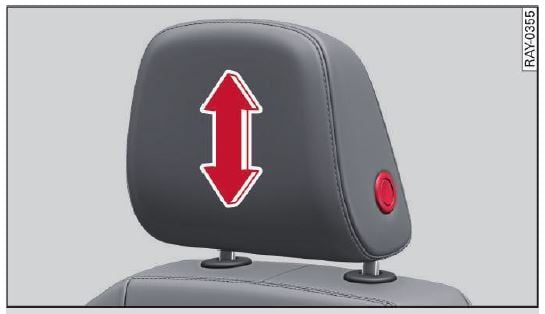
- To adjust the head restraint upward or down-ward, press the button on the side and slide the head restraint. Release the button and slide the head restraint farther until it locks into place.
Rear head restraints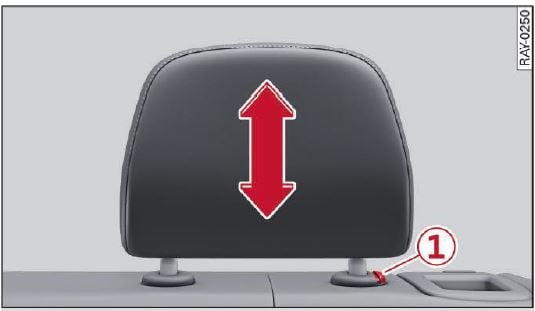 The settings depend on the vehicle equipment.
- To adjust the center head restraint upward, slide it until it locks into place.
- To adjust the outer head restraints upward, press the button 1 and slide the head re-straint. Release the button and slide the head restraint farther until it locks into place.
- To adjust the head restraint downward, press the button 1 and slide the head restraint. Re-lease the button and slide the head restraint farther until it locks into place.
Removing the head restraints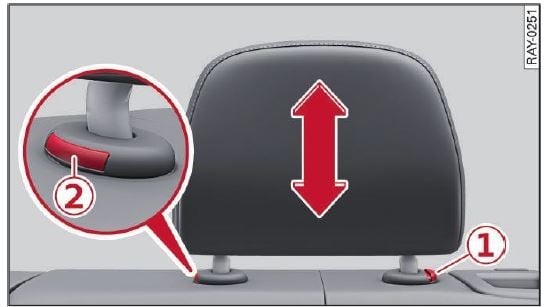
- Fold the backrest forward slightly
- Move the head restraint upward all the way.
- Insert a suitable object, such as the extended vehicle key or mechanical key, into the release point 1 on the inside or outside of the base.
- Press the button 2 and pull the head restraint out of the backrest
Installing the head restraints
This applies to vehicles with removable head restraints
- Fold the backrest forward slightly.
- Slide the posts on the head restraint down into the guides until the posts click into place.
- Press the button 2 and slide the head restraint down. It should not be possible to. remove the head restraint from the backrest without pressing the button.
Safety belts
General information
Each seat is equipped with a three-point safety belt. Safety belts that are worn correctly are the most effective way to reduce the risk of serious or fatal injuries in a collision. Therefore, wear your safety belt correctly and make sure that all persons in the vehicle are also wearing their safety belts correctly when the vehicle is moving.
Even though your vehicle is equipped with an airbag system, each person in the vehicle must still always wear the appropriate safety belt. In addition to their normal protective function, safety belts also hold vehicle occupants in the correct seating position in the event of a collision so that the airbags can deploy correctly and provide additional protection. Safety belts protect during collisions when the airbags do not deploy or if they have already deployed.
Warning
The risk of serious or fatal injury increases if the safety belt is not fastened, if it is worn incorrectly, or damaged.
- All vehicle occupants, including the driver, must fasten their safety belts correctly before every trip and must always keep their safety belts fastened during the trip, regardless of whether the seat is equipped with an airbag or not. This also applies to children that are seated in a child safety seat that is appropriate for their weight and age and that is secured with a safety belt.
- In the event of a collision, vehicle occupants who are not wearing safety belts could be propelled through the vehicle interior and collide with vehicle components, such as the steering wheel, instrument panel, windshield, or doors. In some situations, vehicle occupants could also be ejected from the vehicle. Vehicle occupants in the rear seats who do not wear safety belts not only endanger themselves but also other persons in the vehicle.
- Only one person may be fastened with a safety belt at a time. Never secure more than one person, including children, with a single safety belt.
- Never allow children or infants to ride on another person’s lap and be belted into the safety belt with them.
- Insert the belt buckle only in the belt latch belonging to the corresponding seat, so that the protective function is not impaired.
- To ensure the maximum protective function of the safety belts, all persons in the vehicle must sit in the correct seating position.
- Check the condition of your vehicle’s safety belts regularly. If you find damage to the belt webbing, the belt connections, the retractor, or the buckle, have the damaged safety belt replaced by an authorized Audi dealer or authorized Audi Service Facility.
- The safety belts must not be removed or modified in any way. Do not attempt to repair the safety belts yourself.
- Safety belts that are strained during an accident must be replaced by an authorized Audi dealer or authorized Audi Service Facility.
Correct safety belt positioning
To ensure the safety belt is positioned correctly, make sure of the following points:
- The lap portion of the safety belt must be located across the lap.
- The shoulder portion of the safety belt must rest over the centre of the shoulder.
- The safety belt must always rest flat and securely on the body.
For pregnant women, the safety belt must rest evenly across the chest and as low and flat as possible on the lap, so that no pressure is applied to the lower abdomen. This should be done throughout the entire pregnancy.
Warning
Incorrect safety belt positioning can cause serious injury in the event of an accident or during sudden braking or driving maneuvers.
- Never drive with the backrest reclined extremely far. The more the backrest is tilted back, the greater the risk of injury due to the safety belt being routed incorrectly.
- The safety belt itself for a loose safety belt can cause serious injuries if it shifts onto soft areas of the body, such as the stomach.
- The shoulder portion of the safety belt must lie over the center of the shoulder and chest, and never under the arm, behind the back, or across the neck or face.
- The lap portion of the safety belt must lie across the lap and never over the stomach.
- The safety belt must lie flat and securely on the upper part of the body and the lap.
- The belt webbing must not be pinched or twisted, or rub against sharp edges.
- If the safety belt height is set incorrectly and/or the safety belt is routed incorrectly, then the safety belt’s protective function will be impaired in the event of an accident. Make sure the safety belt is at the right height and is routed correctly for the person in the vehicle who is using it.
- A safety belt that is too loose may lead to injuries during an accident because your body will move farther forward due to kinetic energy and will be stopped abruptly by the belt.
- Heavily bulky, loose clothing (for example, a coat over a sports jacket) may prevent the seat and safety belts from functioning correctly.
- Do not position the safety belt over hard or breakable objects (such as glasses, pens, etc).
- The lap belt portion of the safety belt must sit as low as possible on the lap of pregnant women and lie flat under the belly.
Note
Make sure that there are no hook-and-loop fasteners or sharp objects such as zippers or rivets on clothing in the area where the safety belt is worn. Otherwise, the safety belt could be damaged.
Fastening and unfastening safety belts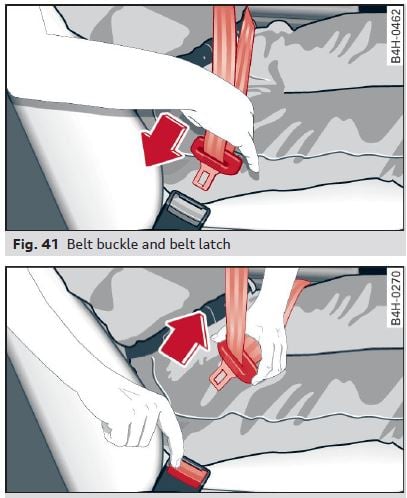 Observe the safety precautions.
Fastening the safety belt
- Pull the safety belt by the belt buckle evenly across your chest and lap.
- Insert the belt buckle in the belt latch belonging to the seat until it audibly engages.
- Pull on the belt to make sure that the belt is securely locked in the latch.
Unfastening the safety belt
- Press the red button on the belt latch. The belt buckle will pop out.
- Guide the belt back by hand so that the safety belt can roll up more easily.
Overview of safety belt displays If the indicator light turns on or flashes, a safety belt is not fastened or it has been unbuck-led while driving. There may be additional audio warning signals.
Additionally, the safety belts in the rear are monitored by the following indicator lights

 If this indicator light turns on, the safety belt for the rear seat has been fastened.
Adjusting the height of the safety belt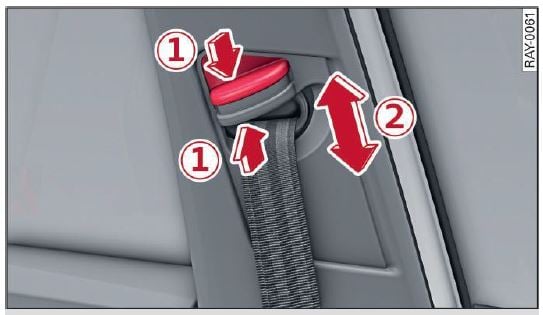
- To move the belt higher, slide the safety belt relay 2 upward.
- To move the belt lower, press the release button 1 and slide the safety belt relay 2 downward.
- To check if the safety belt relay is securely locked in place, pull firmly on the belt.
Information about the automatic belt retractor
The safety belts are equipped with an automatic belt retractor. This automatic retractor allows the safety belt to be pulled all the way out when the belt is pulled slowly. However, the automatic re-tractor locks during sudden braking maneuvers. It also locks the belts when accelerating, driving uphill, and driving around curves.
Information about the belt force limiter
Safety belts with belt force limiters reduce the force placed on the body by the safety belts dur-ing a collision.
Information about the belt retractor
After unfastening the safety belt, the electric motor in the reversible belt tensioner will roll the belt up.
Information about the belt tensioner
Reversible safety belt tensioning
Safety belts may be tightened with reversible belt tensioners when you start driving and in cer-tain driving situations. If the safety belt is too loose, it will be tightened so that the belt will rest closer to the body.
Non-reversible (pyrotechnic) safety belt tensioning
In some collisions, pyrotechnic belt tensioners may secure the safety belts so that they cannot loosen. This reduces forward movement of the persons in the vehicle. Smoke may be released when pyrotechnic belt tensioners deploy. This is not a sign of a vehicle fire.
WARNING
The pyrotechnic system can only provide pro-tection during one collision. If the pyrotechnic belt tensioners deploy, the pretensioning sys-tem must be replaced by an authorized Audi dealer or authorized Audi Service Facility.
Useful Links:
2023 Audi Q5 Review, Price, Features and Mileage (Brochure)