
2019 Jeep Renegade Owner’s Manual
The 2019 Jeep Renegade is a small SUV that has the rugged style of the Jeep brand in a size that is better for cities. It looks like a Jeep and has all-wheel drive and optional off-road packages, so it’s good for both driving in the city and going on weekend activities. The Renegade has two powerful engines, one of which is a fuel-efficient turbocharged four-cylinder. It also has a well-designed cabin with technology that is easy to use. It stands out in its category because it can go anywhere. This makes it a great choice for people who want the flexibility and iconic Jeep DNA in a small, easy-to-drive package.
SERVICING AND MAINTENANCE
SCHEDULED SERVICING
Your vehicle is equipped with an automatic oil change indicator system. The oil change indicator system will remind you that it is time to take your vehicle in for scheduled maintenance. Based on engine operation conditions, the oil change indicator message will illuminate the instrument cluster. This means that service is required for your vehicle. Operating conditions such as frequent short trips, trailer tow, and extremely hot or cold ambient temperatures will influence when the “Change Oil” or “Oil Change Required” message is displayed. Severe Operating Conditions can cause the change oil message to illuminate as early as 3,500 miles (5,600 km) since the last reset. Have your vehicle serviced as soon as possible, within the next 500 miles (805 km).
An authorized dealer will reset the oil change indicator message after completing the scheduled oil change.
NOTE: Under no circumstances should oil change intervals exceed 10,000 miles (16,000 km), one year, or 350 hours of engine run time, whichever comes first. The 350 hours of engine run or idle time is generally only a concern for fleet customers.
Severe Duty All Models
Change Engine Oil at 4,000 miles (6,500 km) or 350 hours of engine run time if the vehicle is operated in a dusty and off-road environment or is operated predominately at idle or only very low engine RPMs. This type of vehicle use is considered Severe Duty.
NOTE: The Oil Change Indicator will not illuminate under these conditions.
Once A Month Or Before A Long Trip:
- Check engine oil level.
- Check the windshield washer fluid level.
- Check the tire inflation pressures and look for unusual wear or damage.
- Check the fluid levels of the coolant reservoir, and brake master cylinder reservoir, and fill as needed.
- Check the function of all interior and exterior lights.
Mandatory service
- The engine air cleaner should be inspected at every oil change if used in dusty areas.
- The oil and oil filter replacement must be carried out when indicated by a warning light or message on the instrument panel, or in any case should not exceed 1 year or 10,000 miles (16,000 km).
- The spark plug change is distance-based only, yearly intervals do not apply. The following are essential to ensure correct operation and prevent serious damage to the engine:
- Only use spark plugs of the same make and type which are specially certified for such engines (refer to “Fluids and Lubricants” in “Technical Specifications” for further information).
- Strictly comply with the spark plug replacement interval given in the “Maintenance Schedule” for spark plug replacement.
- Contact an authorized dealer if you have any questions.
- The brake fluid change interval is time-based only, mileage intervals do not apply.
- Always only use the liquids shown in the handbook for topping up after having checked that the system is not damaged.
- If the engine oil quality detected by the vehicle diagnostics is lower than 20%, it is advisable to replace the engine oil and engine filter in order to avoid another service operation after a short time.
- The maximum mileage is 75000 miles (120,000 km). The belt must be replaced every 6 years, regardless of the distance traveled. If the vehicle is used in heavy conditions (dusty areas, cold climates, urban driving, long periods of idling), the maximum mileage is 37,500 miles (60,000 km). The belt must be replaced every 4 years regardless of the mileage.
WARNING
- You can be badly injured working on or around a motor vehicle. Do only service work for which you have the knowledge and the right equipment. If you have any doubt about your ability to perform a service job, take your vehicle to a competent mechanic.
- Failure to properly inspect and maintain your vehicle could result in a component malfunction and affect vehicle handling and performance. This could cause an accident.
ENGINE COMPARTMENT 1.3L Turbo Engine
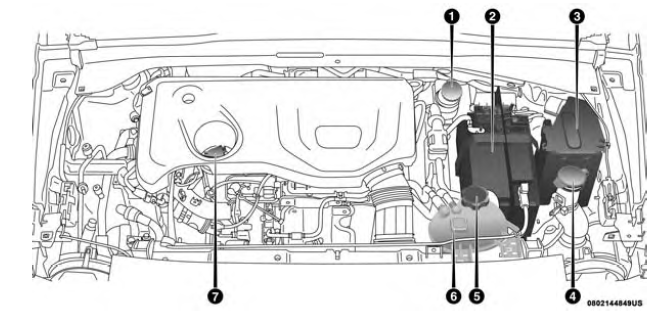
- Brake Fluid Reservoir
- Battery
- Power Distribution Center (Fuses)
- Washer Fluid Reservoir
- Engine Coolant Pressure Cap
- Engine Coolant Reservoir
- Oil Fill Cap/Engine Oil Dipstick
Checking Oil Level
To ensure proper engine lubrication, the engine oil must be maintained at the correct level. Check the oil level at regular intervals, such as at every fuel stop. The best time to check the engine oil level is about five minutes after a fully warmed-up engine is shut off.
Checking the oil while the vehicle is on level ground will improve the accuracy of the oil level readings. There are three possible dipstick types,
- Crosshatched zone.
- Crosshatched zone marked SAFE.
- Crosshatched zone marked with MIN at the low end of the range and MAX at the high end of the range.
- Crosshatched zone marked with dimples at the MIN and the MAX ends of the range.
NOTE: Always maintain the oil level within the crosshatch markings on the dipstick.
Adding 1 quart (1.0 liters) of oil when the reading is at the low end of the dipstick range will raise the oil level to the high end of the range marking.
CAUTION: Overfilling or underfilling the crankcase will cause aeration or loss of oil pressure. This could damage your engine.
Cooling System
WARNING
- You or others can be badly burned by hot engine coolant (antifreeze) or steam from your radiator. If you see or hear steam coming from under the hood, do not open the hood until the radiator has had time to cool. Never open a cooling system pressure cap when the radiator or coolant bottle is hot.
- Keep hands, tools, clothing, and jewelry away from the radiator cooling fan when the hood is raised. The fan starts automatically and may start at any time, whether the engine is running or not.
- When working near the radiator cooling fan, disconnect the fan motor lead or turn the ignition to the OFF mode. The fan is temperature-controlled and can start at any time the ignition is in the ON mode.
Coolant Checks
Check engine coolant (antifreeze) protection every 12 months (before the onset of freezing weather, where applicable). If the engine coolant (antifreeze) is dirty or rusty in appearance, the system should be drained, flushed, and refilled with fresh engine coolant (antifreeze). Check the front of the A/C condenser for any accumulation of bugs, leaves, etc. If dirty, clean by gently spraying water from a garden hose vertically down the face of the condenser.
Adding Washer Fluid
The windshield washer fluid reservoir is located in the engine compartment, and the fluid level should be checked at regular intervals. Fill the reservoir with windshield washer solvent (not engine coolant/ antifreeze). Refer to “Engine Compartment” in this section for further information.
WARNING: Commercially available windshield washer solvents are flammable. They could ignite and burn you. Care must be exercised when filling or working around the washer solution.
Maintenance-Free Battery
Your vehicle is equipped with a maintenance-free battery. You will never have to add water, nor is periodic maintenance required.
WARNING
- Battery fluid is a corrosive acid solution and can burn or even blind you. Do not allow battery fluid to contact your eyes, skin, or clothing. Do not lean over a battery when attaching clamps. If acid splashes in the eyes or on the skin, flush the area immediately with large amounts of water. Refer to “Jump Starting Procedure” in “In Case Of Emergency” for further information.
- Battery gas is flammable and explosive. Keep flame or sparks away from the battery. Do not use a booster battery or any other booster source with an output greater than 12 Volts. Do not allow cable clamps to touch each other.
- Battery posts, terminals, and related accessories contain lead and lead compounds. Wash hands after handling.
CAUTION
- It is essential when replacing the cables on the battery that the positive cable is attached to the positive post and the negative cable is attached to the negative post. Battery posts are marked positive (+) and negative (-) and are identified on the battery case. Cable clamps should be tight on the terminal posts and free of corrosion.
- If a “fast charger” is used while the battery is in the vehicle, disconnect both vehicle battery cables before connecting the charger to the battery. Do not use a “fast charger” to provide a starting voltage.
DEALER SERVICE
An authorized dealer has the qualified service personnel, special tools, and equipment to perform all service operations in an expert manner. Service Manuals are available which include detailed service information for your vehicle. Refer to these Service Manuals before attempting any procedure yourself.
NOTE: Intentional tampering with emissions control systems may void your warranty and could result in civil penalties being assessed against you.
WARNING: You can be badly injured working on or around a motor vehicle. Only do service work for which you have the knowledge and the proper equipment. If you have any doubt about your ability to perform a service job, take your vehicle to a competent mechanic.
FAQ’s
A: The 2019 Jeep Renegade is a compact SUV designed to combine the Jeep brand’s rugged heritage with urban-friendly dimensions.
A: The 2019 Renegade offers several trim levels, including Sport, Latitude, Limited, Trailhawk, and special edition trims like the Altitude and High Altitude.
A: The 2019 Renegade comes with a choice of two engines: a 2.4-liter four-cylinder and a more fuel-efficient 1.3-liter turbocharged four-cylinder.
A: Yes, the 2019 Renegade offers all-wheel drive as an option on most trim levels.
A: The 2019 Renegade can tow up to 2,000 pounds when properly equipped with the available towing package.
A: Yes, the 2019 Renegade Trailhawk trim is designed for off-road adventures, featuring Jeep’s Active Drive Low 4×4 system, off-road suspension, and skid plates.
A: The 2019 Renegade typically seats five passengers.
A: The 2019 Renegade offers a standard 5-inch or an available 7-inch or 8.4-inch touchscreen infotainment system, depending on the trim level.
A: Safety features can include forward collision warning, automatic emergency braking, blind-spot monitoring, and lane departure warning.
A: The 2019 Renegade with the base engine has an EPA-estimated fuel economy ranging from approximately 21 to 24 mpg in the city and 29 to 32 mpg on the highway, depending on the configuration.
A: Exterior color options can vary by trim level and location but may include colors like Alpine White, Omaha Orange, and Jetset Blue.
A: The 2019 Renegade stands out with its distinctive Jeep styling, off-road capabilities, and a user-friendly infotainment system, making it a unique option in the compact SUV segment.
A: The 2019 Renegade typically comes with a 3-year/36,000-mile basic warranty and a 5-year/60,000-mile powertrain warranty.
A: Yes, the 2019 Renegade offers special edition models like the Altitude and High Altitude trims, each with unique features and styling.
A: The 2019 Renegade offers various options and features, including a dual-pane panoramic sunroof, a premium Beats audio system, and a removable My Sky open-air roof system, catering to a wide range of preferences and needs.
Useful Link
2023 Jeep Gladiator Owner’s Manual
2023 Jeep Avenger Owner’s Manual