

2024 Tesla Model X Specifications User Guide
Here in the 2024 Tesla Model X Specifications User Guide, you’ll find cutting-edge technology and speed that can’t be beat. The 2024 Model X pushes the limits of what’s possible with electric cars by combining an exciting driving experience with the most eco-friendly features. This electric SUV sets a new bar for excellence in cars with its sleek exterior and high-end interior features. It looks good on the outside, but it has a powerful electric drivetrain that gives it quick acceleration and a surprisingly smooth ride. With its cutting-edge self-driving features, the Model X makes sure that every trip is safe and easy. The 2024 Tesla Model X is ready to take your driving experience to a whole new level, whether you’re going in the city or across the country.
2023 Tesla Model X Specs, Price, Features, Mileage And Review
Vehicle Identification Number
You can find the VIN at the following locations:
- Touch Controls > Software.
- Stamped on a plate located at the top of the dashboard. This can be seen by looking through the windshield on the driver’s side of the vehicle.

- Printed on the Vehicle Certification label, located on the door pillar. Can be seen when the driver’s door is open.

Emission Control Label
The emission control label is located on the opening face of the liftgate.
NOTE: For vehicles with a model year of 2022 or newer, the emission control label is now located on the inside of the front hood and may not match the label shown.
Vehicle Labeling
It is important to understand your vehicle’s original tire sizes and pressures, and the GVWR (Gross Vehicle Weight Rating) and GAWR (Gross Axle Weight Rating). This information can be found on two labels attached to Model X.
- Tire and Loading Information Label
- Vehicle Certification Label
NOTE: Towing capability is available only if Model X is equipped with the Towing Package.
WARNING: Overloading Model X hurts braking and handling, which can compromise your safety or cause damage.
CAUTION: Never store large amounts of liquid in Model X. A significant spill can cause electrical components to malfunction.
Tire and Loading Information Label
The Tire and Loading Information label provides:
- The maximum number of occupant seating positions.
- The maximum vehicle capacity weight.
- The size of the original tyres.
- The cold inflation pressures for the original front and rear tyres. These pressures are recommended to optimize ride and handling characteristics.
Label Format:
Never change this label, even if you use different tyres in the future.
NOTE: If Model X is loaded to its full capacity, double-check all tyres to ensure they are inflated to their recommended pressure levels.
WARNING: Tire pressures printed on the Tire and Loading Information label DO NOT APPLY to towing. When towing, tyre pressures must be increased. For information about the tyre pressures required when towing, see Towing and Accessories on page 104.
Vehicle Certification Label
The Vehicle Certification label provides:
- • GVWR – Gross Vehicle Weight Rating. The maximum allowable total mass of Model X. This is calculated as the weight of Model X equipped with the heaviest factory selectable options, all passengers, fluids, and cargo.
- GAWR FRT and GAWR RR – Gross Axle Weight Rating for the front and rear axles. The GAWR is the maximum distributed weight that each axle can support.
United States:
Canada:
Mexico:
CAUTION: To prevent damage, never load Model X so that it is heavier than GVWR or exceeds the individual GAWR weights.
Calculating Load Limits
- Locate the statement “The combined weight of occupants and cargo should never exceed XXX lbs or XXX kg” on the “Tire and Loading Information” label.
- Determine the combined weight of all occupants that will ride in the vehicle.
- Subtract the combined weight of the occupants from XXX lbs or XXX kg (see Step 1).
- The resulting figure equals the available cargo load capacity. For example, if the “XXX” amount equals 1400 lbs (635 kg) and there will be five 150 lb (68 kg) passengers in the vehicle, the amount of available cargo capacity is 650 lbs (1400 ‑ 750 (5 x 150) = 650 lbs) or 295 kg (635 ‑ 340 (5 x 68) = 295 kg).
- Determine the combined cargo weight being loaded on the vehicle. That weight must not exceed the available cargo load capacity calculated in Step 4.
WARNING: Trunks are the preferred places to carry objects. In a collision, or during hard braking and sharp turns, loose items in the cabin could injure occupants.
Example Load Limit Calculations
How much cargo Model X can carry depends on the number and weight of passengers. The following calculated load limit examples assume passengers weigh 150 lbs (68 kg). If passengers weigh more or less, available cargo weight decreases or increases respectively.
Driver and one passenger
| Description | Total |
| Vehicle capacity weight | 954 lbs (433 kg) |
| Subtract occupant weight (2 x 150 lbs/68 kg) | 300 lbs (136 kg) |
| Available cargo weight | 654 lbs (297 kg) |
Driver and four passengers
| Description | Total |
| Vehicle capacity weight | 954 lbs (433 kg) |
| Subtract occupant weight (5 x 150 lbs/68 kg) | 750 lbs (340 kg) |
| Available cargo weight | 204 lbs (93 kg) |
When carrying cargo, distribute the weight as evenly as possible between the front and rear trunks. For maximum load limits specific to the trunks, see Front Trunk Load Limit on page 39 and Rear Trunk Load Limits on page 37.
Exterior Dimensions
| Callout | Description** | Measurement (in) | Measurement (mm) |
| A | Overall Length | 199.1 | 5,057 |
| B | Overall Width (including mirrors) Overall Width (excluding mirrors) | 89.4
78.7 |
2,271
1,999 |
| C | Overall Height*:
– suspension set to medium – suspension set to highest** |
66.1
68.5 |
1,680
1,740 |
| D | Wheel Base | 116.7 | 2,965 |
| E | Overhang – Front | 38.9 | 988 |
| F | Overhang – Rear | 43.5 | 1,104 |
| G | Ground Clearance*:
– suspension set to lowest – suspension set to medium – suspension set to highest** |
5.7
6.6 8.1 |
146
166 206 |
| H | Track – Rear | 67.3 | 1,710 |
| Values are approximate and based on 20″ wheels. Values can vary depending on a vehicle’s options and various other factors.
When a vehicle is in Transport Mode, the suspension is automatically set to the highest setting. |
|||
CAUTION: Depending on configuration (such as suspension height or wheel selection), your vehicle’s liftgate can open up to approximately 8 feet (2.5 meters) high. See Adjusting Liftgate Opening Height on page 36 to adjust the liftgate height and prevent it from coming into contact with low ceilings or other objects.
Interior Dimensions
| Area | Row | Measurement (in) | Measurement (mm) |
| Head Room | First | 41.7 | 1,059 |
| Second (5/7 seats) | 41.0 | 1,042 | |
| Second (6 seats) | 40.9 | 1,040 | |
| Third | 37.1 | 944 | |
| Leg Room | First | 41.1 | 1,046 |
| Second (5/7 seats) | 38.7 | 983 | |
| Second (6 seats) | 39.8 | 1,012 | |
| Third (6 seats) | 32.2 | 819 | |
| Third (7 seats) | 29.8 | 756 | |
| Shoulder Room | First | 60.7 | 1,543 |
| Second (5/7 seats) | 56.9 | 1,446 | |
| Second (6 seats) | 56.8 | 1,442 | |
| Third | 40.7 | 1,034 | |
| Hip Room | First | 55.7 | 1,414 |
| Second (5/7 seats) | 58.9 | 1,496 | |
| Second (6 seats) | 59.0 | 1,498 | |
| Third | 38.7 | 982 |
Cargo Volume
5-Seater Cargo Volumes
| Area | Volume (liters) | Volume (cubic ft) |
| Front trunk | 183 | 6.5 |
| Behind the first row, the second row folded flat | 2,410 | 85.1 |
| Behind the second row | 1,050 | 37.1 |
| Maximum total cargo volume with driver and front passenger | 2,593 | 91.6 |
| Maximum total cargo volume with 5 passengers | 1,233 | 43.5 |
6-Seater Cargo Volumes
| Area | Volume (liters) | Volume (cubic ft) |
| Front trunk | 183 | 6.5 |
| Behind the first row, the second row is in max cargo position, the third row is folded flat | 2,431 | 85.8 |
| Behind the second row, the third row folded flat | 935 | 33 |
| Behind the third row | 425 | 15 |
| Maximum total cargo volume with driver and front passenger | 2,614 | 92.3 |
| Maximum total cargo volume with 6 passengers | 608 | 21.5 |
7-Seater Cargo Volumes
| Area | Volume (liters) | Volume (cubic ft) |
| Front trunk | 183 | 6.5 |
| Behind the first row, the second row folded flat | 2,314 | 81.7 |
| Area | Volume (liters) | Volume (cubic ft) |
| Behind the second row, the third row folded flat | 957 | 33.8 |
| Behind the third row | 425 | 15 |
| Maximum total cargo volume with driver and front passenger | 2,497 | 88.2 |
| Maximum total cargo volume with 7 passengers | 608 | 21.5 |
Motor Type
| Motor Type |
Model S Model X |
Model S Plaid Model X Plaid |
| Front and rear motor | AC permanent magnet synchronous motor, liquid-cooled, with variable frequency drive | AC permanent magnet synchronous motor, carbon-fiber-wrapped rotor, liquid-cooled, with variable frequency drive (2x motors in the rear) |
Transmission
| Transmission | Model X | Model X Plaid |
| Type | Single speed fixed gear | Single speed fixed gear |
| Overall Final Drive Ratio | Front unit motor: 7.56:1 Rear unit motor: 9.04:1 | Front unit motor: 7.56:1 Rear unit motor: 7.56:1 |
| Reverse Gear | Reverse direction of motor, limited to 15 mph (24 km/h) | Reverse direction of motor, limited to 15 mph (24 km/h) |
Steering
| Steering | Specifications |
| Type | Variable rack and pinion with electronic power steering, speed-sensitive |
| Number of turns lock to lock | 2.33 |
| Turning Circle (curb to curb) | 40.3 ft/12.3 m |
Brakes
| Brakes | Specifications |
| Type | 4-wheel anti-lock braking system (ABS) with Electronic Brake Force Distribution, Integrated Advanced Stability Control and Electronic Accelerator pedal actuated regenerative braking system |
| Calipers | Front: Four-piston, fixed |
| Rear: Single piston, floating | |
| Rotor Diameters (ventilated) | Front: 15.59”/395 mm |
| Rear: 14.37”/365 mm | |
|
Front Rotor thickness |
New: 1.26”/32 mm |
| Service limit: 1.18”/30 mm | |
| Rear Rotor thickness | New: 1.10”/28 mm |
| Service limit: 1.02”/26 mm |
| Front Brake Pad Thickness (excluding back plate) | New: 0.41”/10.5 mm (MIN) |
| Service limit: 0.09”/ 2.3 mm | |
| Rear Brake Pad Thickness (excluding back plate) | New: 0.33”/8.5 mm (MIN) |
| Service limit: 0.11”/ 2.7 mm | |
| Parking brake | Electrically actuated parking brake callipers |
Suspension
| Suspension | Specifications |
| Front | Independent, double wishbone, air spring with adaptive damper, stabilizer bar |
| Rear | Independent, multi-link, air spring with adaptive damper, stabilizer bar |
Battery – Low Voltage
| Battery – Low Voltage | Specifications |
| Rating | 6.9 amp hour |
| Voltage | 15.5V |
Battery – High Voltage
| Battery – High Voltage | Specifications |
| Type | Liquid-cooled lithium-ion (Li-ion) |
| Nominal Voltage | 407 V DC |
| Temperature Range | Do not expose Model X to ambient temperatures above 149° F (65° C) or below -22° F (-30° C) for more than 24 hours at a time. |
Wheel Specifications (Factory)
| Wheel Type | Size | Offset (mm) |
| 20″ Front | 9.0J x 20 | 40 |
| 20″ Rear | 10.0J x 20 | 35 |
| 22″ Front | 9.0J x 22 | 40 |
| 22″ Rear | 10.0J x 22 | 35 |
| Lug Nut Torque | 129 lb. ft (175 Nm) |
| Lug Nut Socket Size | 21 mm |
NOTE: For instructions on how to jack/lift Model X, see Jacking and Lifting on page 215.
Tire Specifications (Factory)
| Tire Type | Location | Size |
| In U.S., Canada, Puerto Rico and Korea: | ||
| 20″ All Season | Front Rear | 265/45R20
275/45R20 |
| 22″ All Season | Front Rear | 265/35R22
285/35R22 |
| In Mexico: | ||
| 20″ Summer | Front Rear | 255/45R20
275/45R20 |
| 22″ Summer | Front Rear | 265/35R22
285/35R22 |
| Tire pressures vary depending on the type of tyres fitted. Refer to the tire pressures printed on the Tire and Loading Information label. This label is located on the centre door pillar and is visible when the driver’s door is open (see Maintaining Tyre Pressures on page 203). | ||
| Winter tyres can be purchased from a Tesla service centre or may be available for purchase on the Tesla website. | ||
2023 Tesla Model X Specs, Price, Features, Mileage And Review
Understanding Tire Markings
Laws require tyre manufacturers to place standardized information on the sidewall of all tyres. This information identifies and describes the fundamental characteristics of the tyre. It also provides the tyre identification number (TIN) for certification of safety standards and in case of a recall.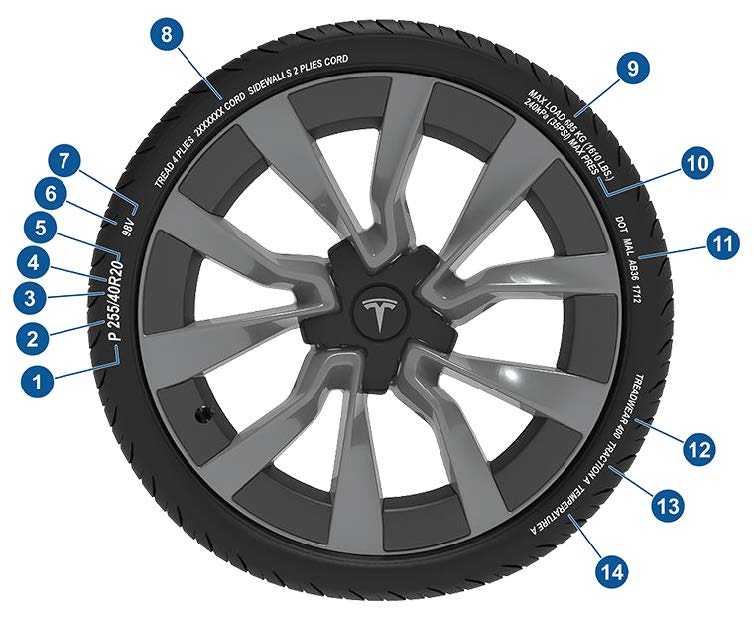
- Tire category: P indicates that the tyre is for passenger vehicles.
- Tyre width: This 3-digit number is the width (in millimetres) of the tire from sidewall edge to sidewall edge.
- Aspect ratio: This 2-digit number is the sidewall height as a percentage of the tread width. So, if the tread width is 205 mm, and the aspect ratio is 50, the sidewall height is 102 mm.
- Tyre construction: R indicates that the tire is of Radial ply construction.
- Wheel diameter: This 2-digit number is the diameter of the wheel rim in inches.
- Load index: This 2 or 3-digit number is the weight each tyre can support. This number is not always shown.
- Speed rating: When stated, indicates the maximum speed (in mph) at which the tyre can be used for extended periods. Q=99 mph (160 km/h), R=106 mph (170 km/h), S=112 mph (180 km/h), T=118 mph (190 km/h), U=124 mph (200 km/h), H=130 mph (210 km/h), V=149 mph (240 km/h), W=168 mph (270 km/h), Y=186 mph (300 km/h), (Y)=vehicle’s top speed (exceeds the “Y” rating).
- Tyre composition and materials: The number of plies in both the tread area and the sidewall area indicates how many layers of rubber-coated material make up the structure of the tire. Information is also provided on the type of materials used.
- Maximum tyre load: The maximum load which can be carried by the tyre.
- Maximum permissible inflation pressure: This pressure should not be used for normal driving.
- U.S. DOT Tire Identification Number (TIN): Begins with the letters DOT and indicates that the tire meets all federal standards. The next 2 digits/letters represent the plant code where it was manufactured, and the last 4 digits represent the week and year of manufacture. For example, the number 1712 is used to represent the 17th week of 2012. The other numbers are marketing codes used at the manufacturer’s discretion. This information can be used to contact consumers if a tyre defect requires a recall.
- Treadwear grade: This number indicates the tyre’s wear rate. The higher the treadwear number is, the longer it should take for the tread to wear down. A tyre rated at 400, for example, lasts twice as long as a tyre rated at 200.
- Traction grade: Indicates a tyre’s ability to stop on wet roads. A higher graded tyre should allow you to stop your vehicle at a shorter distance than a tyre with a lower grade. Traction is graded from highest to lowest as AA, A, B, and C.
- Temperature grade: The tyre’s resistance to heat is grade A, B, or C, with A indicating the greatest resistance. This grading is provided for a correctly inflated tyre, which is being used within its speed and loading limits.
Uniform Tire Quality Grading
The following information relates to the tyre grading system developed by the National Highway Traffic Safety Administration (NHTSA), which grades tyres by tread wear, traction and temperature performance. Tires that have deep tread, and winter tires, are exempt from these marking requirements.
Where applicable, quality grades are found on the tyre’s sidewall between the tread shoulder and maximum section width. For example:
- TREADWEAR 180
- TRACTION AA
- TEMPERATURE A
The quality grades are described next.
NOTE: In addition to the marking requirements, passenger car tyres must conform to Federal Safety Requirements.
Treadwear
The treadwear grade is a comparative rating based on the wear rate of the tyre when tested under controlled conditions on a specified government test course.
For example, a tyre graded 150 wears one and a half times better on a government test course than a tyre graded 100. The relative performance of tyres depends on the actual conditions of their use, however, and can depart significantly from the norm due to variations in driving habits, service practices, road characteristics, and climate.
Traction
The traction grades, from highest to lowest, are AA, A, B, and C. These grades represent a tyre’s ability to stop on wet pavement as measured under controlled conditions on test surfaces of asphalt and concrete. A tyre marked C might have poor traction performance.
WARNING: Defective tyres are dangerous. Do not drive if a tyre is damaged, excessively worn, or inflated to an incorrect pressure. The safety of the vehicle and occupants can be adversely affected. Check tyres regularly for wear and to ensure there are no cuts, bulges or exposure of the ply/cord structure.
WARNING: The traction grade assigned to the tire is based on straight-ahead braking tests, and does not include: acceleration, cornering, hydroplaning or peak traction characteristics.
Temperature
The temperature grades are A (the highest), B, and C, representing the tyre’s resistance to the generation of heat and its ability to dissipate heat when tested under controlled conditions on a specified indoor laboratory test wheel. Sustained high temperatures can cause the tyre to degenerate and reduce tyre life, and excessive temperature can lead to sudden tyre failure.
Grade C corresponds to the minimum level of performance that all passenger car tyres must meet under the Federal Motor Safety Standard No. 109. Grades B and A represent levels of performance on the laboratory test wheel that exceed the minimum requirements.
WARNING: A tyre’s temperature grade is established for a tyre that is properly inflated and not overloaded. Excessive speed, under-inflation, or excessive loading, either separately or in combination, can cause heat buildup and possible tyre failure.
Tire and Loading Glossaries
General Wheel and Tire Terms
| Accessory Weight | The combined weight (over those items replaced) of items available as factory-installed equipment. |
| Bead | The inner edge of a tyre is shaped to fit to the rim and form an air-tight seal. The bead is constructed of steel wires which are wrapped, or reinforced, by the ply cords. |
| Cold Tire Pressure | The air pressure in a tire that has been standing more than three hours, or driven for less than one mile. |
| Curb Weight | The weight of a standard vehicle, including any optional equipment fitted, and with the correct fluid levels. |
| Gross Vehicle Weight | The maximum permissible weight of a vehicle with driver, passengers, load, luggage, and equipment. |
| kPa (kilo pascal) | A metric unit is used to measure pressure. One kilo pascal equals approximately 0.145 psi. |
| Maximum Inflation Pressure |
The maximum pressure to which the tyre should be inflated. This pressure is given on the tyre sidewall in psi (lbf/in2). CAUTION: This pressure marked on the tyre is the maximum allowed by the tyre manufacturer. It is not the pressure Tesla recommends using for Model X. |
| Maximum Loaded Vehicle Weight | The sum of curb weight, accessory weight, vehicle capacity weight, and production options weight. |
| Production Options Weight | The combined weight options installed weigh more than 3 lb (1.4 kg) than the standard items that they replaced and are not already considered in curb or accessory weights. |
| PSI (lbs/in2) | Pounds per square inch (the unit used to measure tyre pressure). |
| Recommended Tire Inflation Pressure | Tyre inflation pressure, established by Tesla, is based on the type of tyres that are mounted on the vehicle at the factory. This information can be found on the Tire and Loading Information label located on the door pillar. |
| Rim | The metal support for a tyre, or tyre and tube, upon which the tyre beads are seated. |
| Vehicle Capacity Weight | The number of seats multiplied by 150 lbs (68 kg) plus the rated amount of load/luggage. |
Load Carrying Definitions
| Normal occupant weight | 68 kilograms (150 lbs) times the number of occupants specified in the second column of the tables for calculating load limits (see Vehicle Loading on page 219). |
| Occupant distribution | Distribution of occupants in a vehicle. |
| Passenger car tyre | (P or Hard Metric) A tyre intended for use on passenger cars, multipurpose passenger vehicles, and trucks, that have a Gross Vehicle Weight Rating (GVWR) of 10,000 lbs (4536 kg) or less. |
| Light truck tire | (LT) A tyre for use where additional load-carrying capability is needed. |
| Rim diameter | Nominal diameter of the bead seat. |
| Rim size designation | Rim diameter and width. |
| Rim type designation | The manufacturing industry’s designation for a rim by style or code. |
| Rim width | Nominal distance between the rim’s flanges. |
| Vehicle maximum load on the tyre | Load on an individual tyre is determined by distributing to each axle its share of the maximum loaded vehicle weight and dividing by two. |
| Vehicle normal load on the tyre | Load on an individual tyre that is determined by distributing to each axle its share of the curb weight, accessory weight, and normal occupant weight and dividing by two. |
Pneumatic Radial Tire Definitions
| Bead separation | A breakdown of the bond between components in the bead. |
| Bias ply tyre | A pneumatic tyre in which the ply cords that extend to the beads are laid at alternate angles substantially less than 90 degrees to the centre line of the tread. |
| Carcass | The tire structure, except tread and sidewall rubber which, when inflated, bears the load. |
| Chunking | The breaking away of pieces of the tread or sidewall. |
| Cord | The strands form the plies in the tyre. |
| Cord separation | The parting of cords from adjacent rubber compounds. |
| Cracking | Any parting within the tread, sidewall, or inner liner of the tyre extending to cord material. |
| Extra load tyre | A tyre is designed to operate at higher loads and higher inflation pressure than the corresponding standard tyre. |
| Groove | The space between two adjacent tread ribs. |
| Inner liner | The layer(s) forming the inside surface of a tubeless tyre that contains the inflating medium within the tyre. |
| Inner liner separation | The parting of the inner liner from cord material in the carcass. |
| Load rating | The maximum load that a tyre is rated to carry for a given inflation pressure. |
| Maximum load rating | The load rating for a tyre at the maximum permissible inflation pressure for that tyre. |
| Measuring rim | The rim on which a tyre is fitted for physical dimension requirements. |
| Open splice | Any parting at any junction of tread, sidewall, or inner liner that extends to the cord material. |
| Outer diameter | The overall diameter of an inflated new tyre. |
| Overall width | The linear distance between the exteriors of the sidewalls of an inflated tyre, including elevations due to labelling, decorations, or protective bands or ribs. |
| Ply | A layer of rubber-coated parallel cords. |
| Ply separation | A parting of rubber compound between adjacent plies. |
| Pneumatic tyre | A mechanical device made of rubber, chemicals, fabric steel or other materials, that, when mounted on an automotive wheel, provides traction and contains the gas or fluid that sustains the load. |
| Radial ply tire | A pneumatic tyre in which the ply cords that extend to the beads are laid at substantially 90 degrees to the centre line of the tread. |
| Reinforced tyre | A tyre is designed to operate at higher loads and higher inflation pressures than the corresponding standard tyre. |
| Section width | The linear distance between the exteriors of the sidewalls of an inflated tyre, excluding elevations due to labelling, decoration, or protective bands. |
| Sidewall | The portion of a tyre between the tread and bead. |
| Sidewall separation | The parting of the rubber compound from the cord material in the sidewall. |
| Snow tire | A tyre that attains a traction index equal to or greater than 110, compared to the ASTM E1136-93 (re-approved 2003, incorporated by reference, see §571.5) Standard Reference Test Tire when using the snow traction test as described in ASTM F1805-00 (incorporated by reference, see §571.5), and that is marked with an Alpine Symbol specified in S5.5(i) on at least one sidewall. |
| Test rim | The rim on which a tyre is fitted for testing, and may be any rim listed as appropriate for use with that tyre. |
| Tread | The portion of a tyre that comes into contact with the road. |
| Tread rib | A tread section runs around the circumference of a tyre. |
| Tread separation | The pulling away of the tread from the tyre carcass. |
| Tread wear indicators (TWI) | The projections within the principal grooves are designed to give a visual indication of the degrees of wear of the tread. |
| Wheel-holding fixture | The fixture was used to hold the wheel and tyre assembly securely during testing. |
FAQs
The maximum range of the 2024 Tesla Model X is approximately 360 miles.
The 2024 Tesla Model X can accommodate up to seven passengers comfortably.
The 2024 Tesla Model X can accelerate from 0 to 60 mph in just 4.4 seconds.
The 2024 Tesla Model X is available in both single and dual-motor configurations.
The 2024 Tesla Model X has a towing capacity of up to 5,000 pounds.
The 2024 Tesla Model X has a horsepower rating of up to 670 hp.
Yes, the 2024 Tesla Model X can be charged using a standard household outlet, but it will charge much slower compared to using a dedicated charging station.
The 2024 Tesla Model X offers a cargo capacity of 88 cubic feet with all seats up.
Yes, the 2024 Tesla Model X comes with advanced autopilot features for enhanced driving assistance.
The available interior colour options for the 2024 Tesla Model X include black, white, and tan.
Yes, the 2024 Tesla Model X offers a panoramic glass roof option for an expansive view.
The 2024 Tesla Model X comes equipped with advanced safety features such as collision avoidance, automatic emergency braking, and adaptive cruise control.
Yes, the 2024 Tesla Model X can be equipped with third-row seating for additional passenger capacity.
The 2024 Tesla Model X can achieve a significant charge in as little as 15 minutes using a supercharger station.
Yes, the 2024 Tesla Model X offers a heated steering wheel option for added comfort in cold weather.
Yes, performance upgrades such as Ludicrous Mode are available for the 2024 Tesla Model X for enhanced acceleration.
Useful Links
2023 Tesla Model X Specs, Price, Features, Mileage And Review